What Is the Small Company Audit Exemption in Singapore?
Could your Singapore company qualify for the small company audit exemption this financial year? In this guide, we set out seven checks 3E Accounting runs before advising any client to waive its statutory audit. Since 1 July 2015, section 205C of the Companies Act, read with the Thirteenth Schedule, has let qualifying small companies rely on the audit exemption instead of a statutory audit. This follows Accounting and Corporate Regulatory Authority (ACRA) guidance. Exemption turns on three quantitative thresholds — revenue, total assets and full-time headcount — tested over the immediate past two consecutive financial years. For SMEs, qualifying means skipping a full audit engagement each year. Wrongly relying on the exemption can lead to a breach of audit requirements.
Group structures, new incorporations and shareholder demands complicate the analysis.
How Do You Verify Private Company Status?
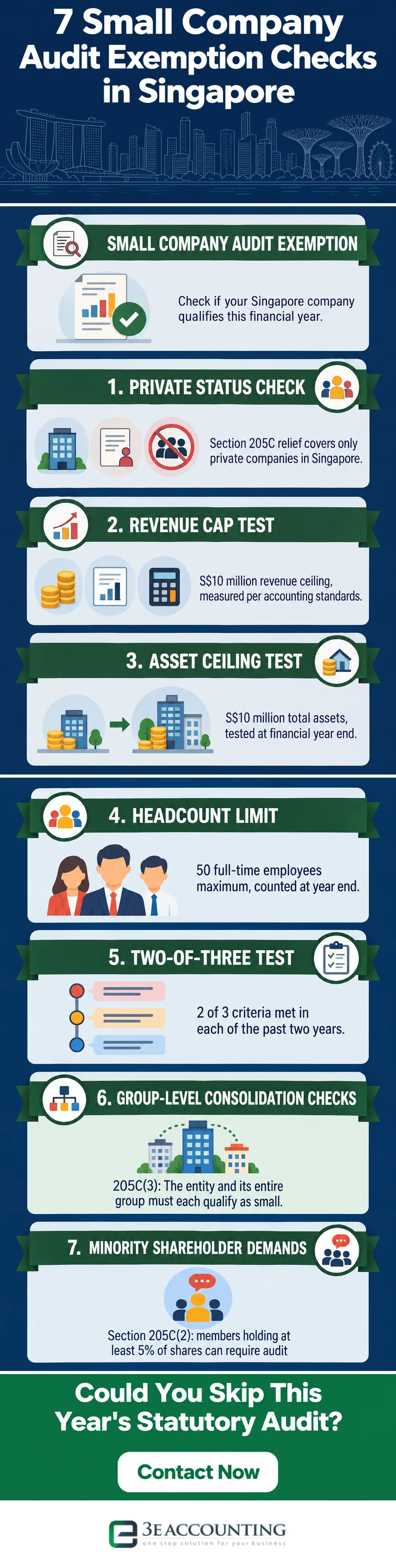
50 members is the constitutional membership limit for a private company, subject to statutory exclusions. Section 205C of the Companies Act restricts the small company exemption to private companies. Public companies, and any entity that ceases to be private during the financial year, cannot rely on the relief. Corporate shareholders do not disqualify you: ACRA confirms the test differs from the former exempt private company regime. Check your constitutional documents and shareholder register before anything else.
How Do You Assess the Annual Revenue Threshold?
Total annual revenue of S$10 million or less for the relevant financial year satisfies the revenue criterion. Measure it from financial statements prepared in accordance with applicable accounting standards — not management accounts. Crossing the cap in one year does not immediately disqualify you, because the test looks at the immediate past two consecutive financial years. In each year, clearing this criterion counts toward the two qualifying thresholds; the criteria met can differ between years.
How Do You Evaluate Total Balance-Sheet Assets?
Total assets of S$10 million or less at financial year end satisfy the asset criterion. Read the figure straight from your statement of financial position, prepared in accordance with applicable accounting standards. This is the second of the three quantitative tests. Asset-heavy SMEs — those holding property, plant and equipment — should verify this line before assuming relief, as valuations move it quickly.
Count Full-Time Employee Headcount
50 or fewer full-time employees at financial year end satisfy the headcount criterion. ACRA counts full-time employees on the payroll at the end of the financial year, making headcount a point-in-time test rather than an average. Part-time and contract arrangements need careful classification. Growing teams should classify and count employees accurately at the snapshot date, because the count is fixed there.
Small company quantitative audit exemption checks
| Criterion | Threshold |
|---|---|
| Annual revenue | S$10 million or less |
| Total assets | S$10 million or less |
| Full-time employees | 50 or fewer at financial year end |
Apply Two-of-Three Quantitative Criteria
Initial qualification: a private company must meet at least 2 of the 3 quantitative criteria in each of the immediate past two consecutive financial years. The qualifying criteria can differ between years. A company that has just been set up can qualify in its opening financial year by satisfying at least 2 of the 3 criteria for that same year. If it misses the mark in year one, it can still qualify in its second financial year by meeting those criteria for that year.
Retaining the exemption: once qualified, the relief persists until the company ceases to be private. It also ends if, in any two consecutive financial years after qualification, the company fails to meet at least two of the three criteria in each of those years. Exemption waives the audit only: the YA 2026 IRAS corporate income tax return is due 30 November 2026. For later years, confirm the current due date on IRAS's website.
Conduct Group-Level Consolidation Checks
Two tests apply under section 205C(3) of the Companies Act: the entity and its entire group must each qualify as small. ACRA's small company concept guidance confirms membership of a group is decided under the accounting standards. The group test covers foreign entities too. For the immediate past two consecutive financial years, the group as a whole must satisfy at least 2 of the 3 thresholds. Use the parent's consolidated financial statements for revenue and assets where prepared. If no consolidated accounts are prepared, aggregate the revenue and assets of all group members. Assess headcount using the group's total full-time employees at financial year end.
Under section 205C(2) of the Companies Act, members holding at least 5% of the total issued shares can require an audit. ACRA guidance confirms such members may serve written notice requiring a statutory audit, overriding the exemption for that financial year. Before assuming relief, review the register of members, shareholders' agreements and any notices received at the registered office. One valid requisition is enough to restore audit obligations.
Could You Skip This Year's Statutory Audit?
3E Accounting reviews your year-end figures, share register and group structure against every ACRA exemption criterion.
Frequently Asked Questions
Your company must be private and meet at least 2 of 3 thresholds — revenue of S$10 million or less, total assets of S$10 million or less, and 50 or fewer full-time employees — for the immediate past two consecutive financial years, per ACRA guidance.
No. ACRA confirms that companies with corporate shareholders can qualify — unlike the former exempt private company regime.
No. Companies less than two years old qualify by meeting the criteria in the current financial year, with a fresh assessment in year two if year one did not qualify.
No. Exempt companies still file annual returns with ACRA and corporate income tax returns with IRAS — the YA 2026 return is due by 30 November 2026, and late or non-filing can draw penalties of up to S$5,000.
Yes. Members holding at least 5% of the total issued shares may serve written notice requiring a statutory audit, overriding the exemption for that financial year.

Abigail Yu
Director
Abigail Yu oversees executive leadership at 3E Accounting Group, leading operations, IT solutions, public relations, and digital marketing to drive business success. She holds an honors degree in Communication and New Media from the National University of Singapore and is highly skilled in crisis management, financial communication, and corporate communications.