
Which AI Business Services Qualify for Singapore Tax Deductions?
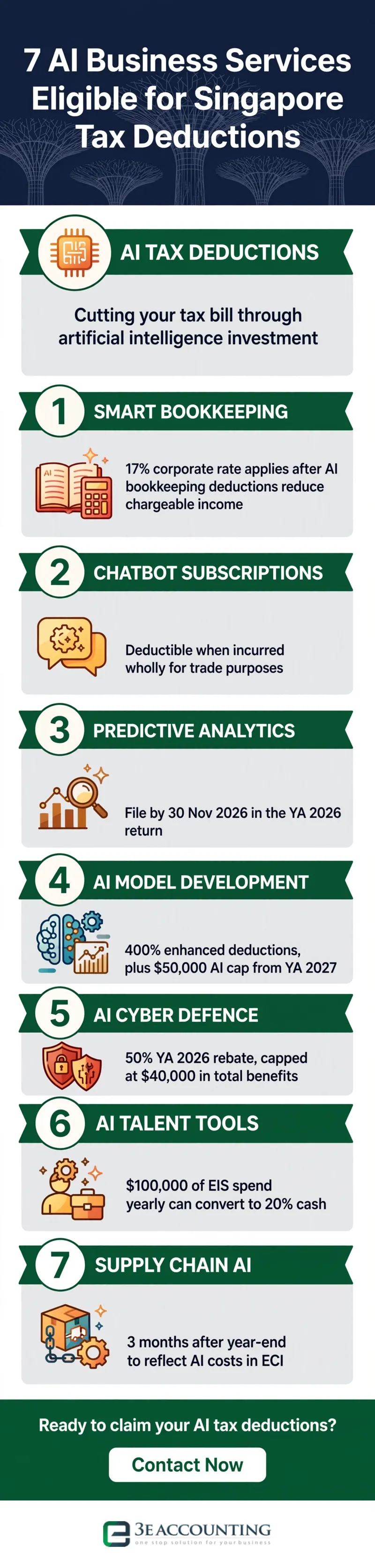
Could your business pay less tax by investing in artificial intelligence? In Singapore, qualifying AI services may be tax-deductible. The Inland Revenue Authority of Singapore (IRAS) has confirmed the 50% corporate income tax rebate for Year of Assessment (YA) 2026. The rebate is capped at $40,000 in total benefits. The Enterprise Innovation Scheme (EIS) delivers 400% deductions on qualifying innovation expenditure. From YA 2027, qualifying AI expenditure of up to $50,000 per YA joins the EIS list at that enhanced rate. In this infographic, we discuss seven AI business services, from bookkeeping platforms to machine learning development. Their costs can qualify for relief, and integrated corporate services can help your business in Singapore capture each claim.
How Are AI Accounting and Bookkeeping Platforms Taxed?
Singapore taxes corporate chargeable income at a flat 17% rate, according to the Inland Revenue Authority of Singapore (IRAS). Qualifying AI-driven bookkeeping, invoicing and reconciliation expenses may reduce chargeable income. Actual tax savings depend on profitability, exemptions and other circumstances. Deductibility depends on the expense's nature, business use and relevant basis period.
- Qualifying revenue subscriptions may be deductible.
- Capital implementation costs may qualify for capital allowances.
GST InvoiceNow requirements are also relevant to digital invoicing for GST-registered businesses. Keeping itemised invoices for each licence strengthens the claim.
Are AI Customer Support Chatbots Tax-Deductible?
Chatbot and virtual-assistant subscriptions may be deductible if they are revenue expenses incurred wholly for trade. Qualifying customer service, licence and usage-based fees are generally claimed for the relevant basis period. Deploying bots across websites and messaging channels modernises service workflows while trimming staffing overhead. Separating business accounts from personal subscriptions keeps the deduction defensible.
Are Predictive Analytics Tools Tax-Deductible?
Deductions for analytics expenses in the relevant basis period belong in the YA 2026 return due by 30 Nov 2026. Business-intelligence, demand-forecasting and data-dashboard subscriptions incurred wholly for trade may be deductible as revenue expenses. Perpetual licences of a capital nature may attract capital allowances. Late filing or non-filing may draw IRAS penalties of up to $5,000. Capturing every qualifying cost on time matters.
Custom AI Algorithm Development
The Enterprise Innovation Scheme (EIS) grants 400% tax deductions on qualifying expenditure for qualifying activities. AI development may qualify under EIS if it meets the relevant conditions for R&D conducted in Singapore. For YA 2027 and YA 2028, it may also qualify for eligible AI business services supplied by another person. For YA 2027 and YA 2028, qualifying AI expenditure joins the list. It receives 400% deductions on up to $50,000 per YA. The deduction is not a tax credit; actual savings depend on the business's tax position.
| Expense or relief | Potential treatment | Limit or timing |
|---|---|---|
| AI software subscriptions | Qualifying revenue expenses may be deductible | Relevant basis period |
| Qualifying AI adoption expenditure | 400% EIS deduction | Up to $50,000 per YA for YA 2027 and YA 2028 |
| Qualifying EIS expenditure for cash conversion | 20% non-taxable cash payout instead of deductions | Up to $100,000 per YA; AI adoption expenditure excluded |
| Qualifying computer equipment | May qualify for capital allowances | Subject to applicable conditions |
AI Cybersecurity Systems
YA 2026 also brings a 50% corporate income tax rebate, capped at $40,000 in total benefits. Autonomous threat-detection platforms and automated risk-monitoring tools compound the relief.
- Qualifying hardware may attract capital allowances as computer equipment.
- Monitoring subscriptions may stay deductible as operating expenses.
Deductions reduce chargeable income first, and the rebate then trims the remaining tax payable.
AI HR and Talent Software
Eligible businesses may convert up to $100,000 of qualifying EIS expenditure per YA into cash. This conversion excludes expenditure under the AI adoption activity. The 20% conversion produces a non-taxable payout instead of deductions on the converted expenditure. Eligibility requires:
- three qualifying full-time local employees
- CPF contributions for at least six months
- timely filing of the income tax return
AI-related training may qualify for enhanced deductions if the course is eligible for Skills and Workforce Development Agency funding. It must also align with the Skills Framework. Software subscriptions may be deductible if they meet the applicable rules. The payout option suits young companies funding growth.
Supply Chain Optimisation AI
Within 3 months of the financial year-end, most companies file their Estimated Chargeable Income (ECI). Some companies are exempt. AI-driven procurement, demand-sensing and inventory-management subscriptions may be deductible operating expenses. They should lower that estimate from the outset. Accurate early declarations reduce later adjustments, while automation trims stock-holding costs independently. Clear records keep each claim defensible in the subsequent tax return. Contact our team for help assessing AI software costs and preparing your ECI.
Ready to Claim Your AI Deductions?
Our Singapore corporate services team helps document qualifying AI expenditure and file each claim accurately with IRAS.
Frequently Asked Questions
Potentially. Business-use subscriptions may be deductible as revenue expenses in the relevant basis period; actual savings depend on profitability, exemptions and other circumstances.
Qualifying expenditure on EIS activities such as R&D and employee training earns a 400% tax deduction. From YA 2027, up to $50,000 of qualifying AI expenditure per YA also qualifies at 400%.
Eligible businesses may convert up to $100,000 of qualifying EIS expenditure per YA into a non-taxable cash payout at 20%, instead of claiming deductions on the converted amount. AI adoption expenditure is excluded, and eligibility conditions apply.
All companies must file their YA 2026 return by 30 Nov 2026 unless granted a waiver, including those that made a loss in financial year 2025. Late filing may draw penalties of up to $5,000.
Yes. Capital expenditure on computers, peripheral equipment and related infrastructure generally qualifies for capital allowances, while recurring subscription and usage fees remain deductible as revenue expenses.

Abigail Yu
Director
Abigail Yu oversees executive leadership at 3E Accounting Group, leading operations, IT solutions, public relations, and digital marketing to drive business success. She holds an honors degree in Communication and New Media from the National University of Singapore and is highly skilled in crisis management, financial communication, and corporate communications.