
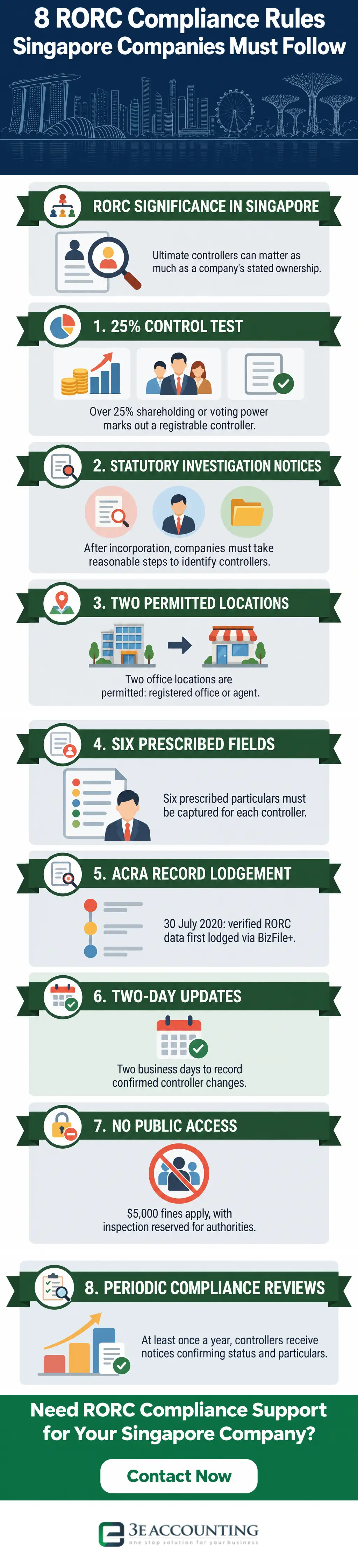
Why Does the Register of Registrable Controllers Matter in Singapore?
Who ultimately controls a company can be as important as the company's stated ownership. Since 31 March 2017, Singapore companies within the RORC regime have had to maintain a Register of Registrable Controllers (RORC), although statutory exemptions apply to certain listed entities and financial institutions. In this guide, we explain RORC compliance Singapore through eight practical rules. Before acting on them, confirm whether your entity is exempt: if your company is a listed entity or a regulated financial institution, check with ACRA. They range from identifying registrable controllers to conducting periodic reviews ahead of each annual return.
The regime is overseen by the Accounting and Corporate Regulatory Authority (ACRA). It was introduced to expose beneficial ownership and deter the misuse of corporate structures. Since 30 July 2020, companies required to maintain an RORC must file their RORC information with ACRA's Central RORC through Bizfile. RORC offences can attract fines of up to $25,000 on conviction for the company and each officer in default. The obligations apply from the moment of company incorporation, whether the business is dormant or actively trading.
Identify Significant Beneficial Controllers
More than 25% of a company's shares or voting power is the significant-interest threshold for a registrable controller. For a company with share capital, significant interest includes holding more than 25% of its shares or voting power; for a company without share capital, it includes a right to more than 25% of its capital or profits. It also applies to individuals who exercise ultimate significant control. This control includes the right to appoint or remove a majority of directors. Businesses must map their ownership chains at incorporation and after every restructuring. Unidentified controllers leave the company and its officers exposed to ACRA enforcement.
Issue Statutory Investigation Notices
After incorporation, Singapore companies must take reasonable steps to identify their controllers and issue statutory notices when circumstances change. They must also send each controller a notice at least once a year to verify the controller's status and particulars. Recipients generally have 30 calendar days after the notice is sent to respond. Ignoring a notice or supplying false information is an offence. Companies should retain copies of every notice and reply as documented evidence of their investigation efforts under the Companies Act 1967.
Establish the Internal Register
2 permitted locations are available for the private RORC. Companies must keep the RORC at their registered office address. They may also keep it at a corporate service provider's office. The register may be held physically or electronically, provided it can be produced without delay when ACRA requests it. Dormant and non-trading companies remain equally bound by this requirement.
Record Full Prescribed Particulars
10 core personal particulars must be captured for each individual controller:
- full name
- any aliases
- residential address
- email address
- contact number
- nationality
- identification type and number
- date of birth
- date of becoming a controller
- date of cessation as a controller, where applicable
The RORC must also state the particulars of the controller's significant interest or significant control; this information is prescribed and should not be omitted.
For a corporate controller, record:
- name
- unique entity number, if any
- registered office address
- email address
- contact number
- legal form
- jurisdiction and law under which it was formed or incorporated
- corporate registrar, if applicable
- registration number, if applicable
- date of becoming a controller
- date of cessation as a controller, where applicable
- particulars of the controller's significant interest or significant control
Accurate particulars are central to RORC compliance Singapore. Incomplete or inaccurate entries undermine the register's validity and invite ACRA scrutiny. Each field should be verified against official identification documents before entry.
Lodge Records With ACRA
30 July 2020 is when Singapore companies began lodging verified RORC data with ACRA through the BizFile+ portal. Under ACRA's current guidance, the private Register of Registrable Controllers remains a local record kept at the company's registered office or a corporate service provider's office. The particulars lodged with ACRA through BizFile+ must match the private RORC.
Where a controller does not respond within 30 calendar days, the company must update its private RORC within seven calendar days after that period ends, note that the particulars are unconfirmed, and lodge the update with ACRA. Companies incorporated from 16 June 2025 must lodge their initial RORC information on the same day as incorporation. Whenever controller particulars change, the corresponding update must be lodged with ACRA within two business days after the private RORC is updated. Engaging a corporate service provider helps prevent missed lodgement deadlines and rejected submissions.
RORC compliance timetable for Singapore companies
| Compliance item | Timing |
|---|---|
| Identify a registrable controller | More than 25% shareholding or voting rights, or significant control |
| Issue a statutory investigation notice | Within 2 business days after the company knows or has reasonable grounds to believe a notice is required |
| Respond to a statutory investigation notice | Within 30 days after the notice is sent |
| Update the internal register after confirmation | Within 2 business days |
| Lodge a Central RORC update after updating the internal register | Within 2 business days |
Update Information Within Two Days
A registrable controller must notify the company within seven calendar days of any change in their particulars or of ceasing to be a registrable controller. The company must then update the private RORC within two business days after receiving that confirmed information. The amended data must in turn be lodged with ACRA's Central RORC within two business days after the private RORC is updated. This keeps the private and central records synchronised and accurate.
Maintain Strict Confidentiality Safeguards
RORC breaches can attract fines of up to $25,000 for the company and its officers. The internal register is also confidential: unlike ACRA's publicly searchable business profile, it cannot be inspected by the general public. Access is restricted to authorised ACRA officers, law enforcement agencies and specified public bodies. Companies should therefore align RORC safeguards with their broader KYC and anti-money laundering controls.
Conduct Periodic Compliance Reviews
At least once a year, each controller must receive a notice to verify that their status and particulars remain correct. For a private company with a 31 December 2025 financial year end, the ACRA Annual Return is due by 31 July 2026. Late lodgement of that filing attracts a penalty of $300 when filed within three calendar months after the due date, or $600 when filed later. Controller records should be verified ahead of each annual return, confirming particulars remain accurate and Central RORC lodgements are current. Regular reviews support sound corporate governance after share transfers, director changes or restructurings that alter control.
Sources: Companies Act 1967, provisions on the Register of Registrable Controllers; ACRA, current Register of Registrable Controllers (RORC) guidance.
Need RORC Compliance Support for Your Singapore Company?
Our corporate secretarial team maintains your RORC, lodges data with ACRA and keeps every statutory deadline on track.
Frequently Asked Questions
Any individual or corporate entity holding more than 25% of a company's shares or voting rights, or exercising significant control such as the right to appoint a majority of directors.
The company must update the private RORC within two business days after receiving confirmed information about a change. The controller must first notify the company within seven calendar days of the change or cessation. The amended data must then be lodged with ACRA's Central RORC within two business days after the private RORC is updated.
No. The internal register is not open to public inspection; access is limited to authorised ACRA officers, law enforcement agencies and specified public bodies.
Verified controller data is uploaded through the BizFile+ portal to ACRA's central register, a requirement that has applied since 30 July 2020.
Companies and their officers can face fines of up to $25,000 for breaches, and ACRA may pursue further enforcement against officers in default.

Abigail Yu
Director
Abigail Yu oversees executive leadership at 3E Accounting Group, leading operations, IT solutions, public relations, and digital marketing to drive business success. She holds an honors degree in Communication and New Media from the National University of Singapore and is highly skilled in crisis management, financial communication, and corporate communications.