
Why Does Your ACRA Financial Statement Filing Route Matter?
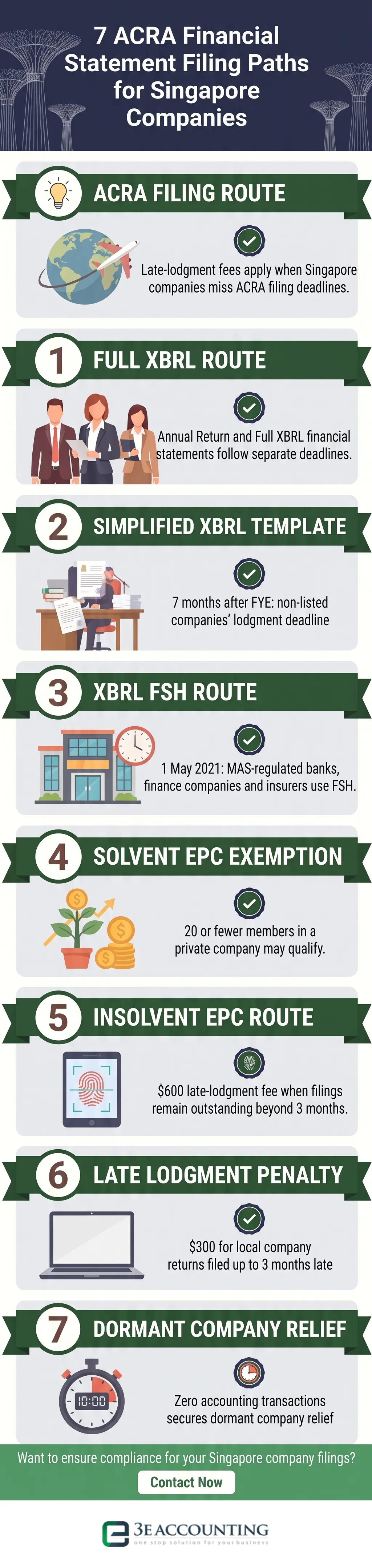
Late-lodgment fees apply when a Singapore company misses its ACRA financial statement filing deadline, but the amount depends on the filing type and how overdue the filing is, reaching up to $600. ACRA filing obligations depend on a company's status, size and regulatory profile, and choosing the wrong route can trigger enforcement action. In this guide, we explain seven financial statement filing paths under the Accounting and Corporate Regulatory Authority (ACRA). Companies that incorporate in Singapore must file financial statements unless an exemption applies. The required format depends on company type. This obligation is separate from tax filings with the Inland Revenue Authority of Singapore (IRAS). Contact our team for guidance on your company's position.
When Does the Full XBRL Filing Route Apply?
Separate deadlines apply to the Annual Return and to the Full XBRL financial-statement format. For Annual Return lodgment, listed companies must lodge within 5 months after financial year end, or 6 months if they have share capital and keep an overseas branch register. Non-listed companies must lodge their annual returns within 7 months after financial year end, or 8 months if they have share capital and keep an overseas branch register.
For the financial-statement format, the Full XBRL template is ACRA's most comprehensive data standard and applies to companies that are required to file in XBRL but do not qualify for Simplified XBRL or Financial Statements Highlights. Some companies outside Simplified XBRL or Financial Statements Highlights may instead fall within PDF-only filing or other exempt categories. It captures primary statements and selected notes to financial statements. Preparation demands rigour and early engagement of professional support.
When Does the Simplified XBRL Filing Route Apply?
Non-listed companies lodge their annual returns within 7 months of financial year end, or within 8 months if they have share capital and keep an overseas branch register. Eligible companies must be smaller and non-publicly accountable. Their revenue and total assets for the current financial year must each not exceed $500,000. They must not be listed or regulated entities. They must also file a PDF copy of financial statements authorised by directors. The Simplified XBRL template requires fewer data elements than the full standard. This lightens preparation for small and medium enterprises using ACRA's BizFinx preparation tool. Confirm eligibility before selecting the template, because the wrong choice delays lodgment.
When Does the Financial Statements Highlights Filing Route Apply?
Since 1 May 2021, MAS-regulated banks, finance companies and insurers use the applicable XBRL FSH (Banks) or XBRL FSH (Insurance) template. The format captures selected key figures rather than full accounts. These companies also file a PDF copy of financial statements authorised by directors. This path reflects the separate supervisory regime for Singapore's financial sector.
Solvent EPC Exemption Route
An exempt private company can be a private company with 20 or fewer members. No corporation may hold a direct or indirect beneficial interest in its shares. It can also be a Government-owned private company declared an EPC by Gazette. Solvent EPCs are exempt from financial statement filing. They submit an online solvency declaration under section 197 of the Companies Act 1967 during Annual Return lodgment. This relieves many family businesses and startups of considerable compliance cost. Inability to meet debts as they fall due removes the exemption.
Comparison of ACRA financial statement filing routes
| Filing route | Who it applies to | Filing outcome |
|---|---|---|
| Full XBRL | Companies required to file XBRL that do not qualify for Simplified XBRL or Financial Statements Highlights | Full XBRL template |
| Simplified XBRL | Eligible small companies | Simplified XBRL template |
| Financial Statements Highlights | MAS-regulated entities | Financial Statements Highlights |
| Solvent EPC exemption | Solvent EPCs | Online solvency declaration |
| Insolvent EPC filing | Insolvent EPCs | Full or Simplified XBRL |
| PDF-only filing | Companies limited by guarantee, foreign company branches and companies approved by ACRA to use other accounting standards | Audited financial statements in PDF |
| Dormant company relief | Qualifying dormant unlisted companies | No financial statement filing |
Insolvent EPC Filing Route
Late lodgment fees reach $600 where filings remain outstanding beyond 3 months. An exempt private company unable to declare solvency loses its exemption and must file financial statements with ACRA in Full or Simplified XBRL. Directors should treat insolvency as a compliance trigger, since creditors and stakeholders may rely on the lodged accounts when assessing the company's position.
PDF-Only Filing Route
Under ACRA's late lodgment penalty framework, a local company's annual return filed up to 3 months late incurs a $300 penalty; foreign companies are subject to an 8-tier $50 to $350 penalty framework. Companies limited by guarantee and companies approved by ACRA to use other accounting standards file director-authorised PDFs. Foreign companies have separate PDF filing requirements. Unlimited Singapore-incorporated companies generally follow the XBRL rules. This route suits entities outside the XBRL mandate. Their obligations arise under their constituting legislation. Audit and PDF obligations can vary by entity type and any applicable exemption.
Dormant Company Relief Route
$500,000 is the total-asset cap at any time during the financial year under the dormant company relief route. Zero accounting transactions during the financial year is the statutory dormancy test. Qualifying dormant companies do not prepare or file financial statements. They must not be listed or subsidiaries of listed companies. Parent companies must also keep consolidated group assets within $500,000. The company must have been dormant from formation or since the previous financial year. Under the Companies Act, specified transactions may be disregarded for dormancy, so not every accounting transaction automatically ends the relief for that financial year.
Which ACRA Filing Path Applies to Your Company?
Our corporate services team maps your company to the correct ACRA route and lodges on time, every year.
Frequently Asked Questions
Smaller, non-publicly accountable companies use Simplified XBRL. Other Singapore-incorporated companies generally use Full XBRL, while MAS-regulated banks, finance companies and insurers use Financial Statements Highlights. Dormant relevant companies and solvent EPCs may be exempt.
A private company with 20 or fewer members and no corporation holding a beneficial interest in its shares. If it is solvent, it is exempt from financial statement filing with ACRA and declares solvency during Annual Return lodgment.
Within 7 months of the financial year end for non-listed companies, or 5 months for listed companies. Financial statements, where required, are filed together with the return.
ACRA imposes a late lodgment fee of $300 when the filing is late within 3 months of the due date, rising to $600 thereafter. Directors may also face enforcement action for persistent non-compliance.
No. The ACRA Annual Return and the IRAS Form C-S, Form C-S (Lite) or Form C are separate obligations. According to IRAS, the YA 2026 Corporate Income Tax Return is due by 30 November 2026.

Abigail Yu
Director
Abigail Yu oversees executive leadership at 3E Accounting Group, leading operations, IT solutions, public relations, and digital marketing to drive business success. She holds an honors degree in Communication and New Media from the National University of Singapore and is highly skilled in crisis management, financial communication, and corporate communications.