
Which Singapore Corporate and Accounting Law Changes Matter for 2026?
Singapore corporate law changes affect nominee registers, climate reporting and director duties. Since 2023, reforms have addressed ownership transparency, sustainability standards and corporate accountability. In this infographic article, we break down six updates every director and business owner should review for applicability before the next filing season. Directors who miss applicable requirements face penalties, disqualification risk and due-diligence friction with banks and investors. Smaller companies must also keep their applicable registers, filings and board practices current.
What Are the Nominee Director Disclosure Rules?
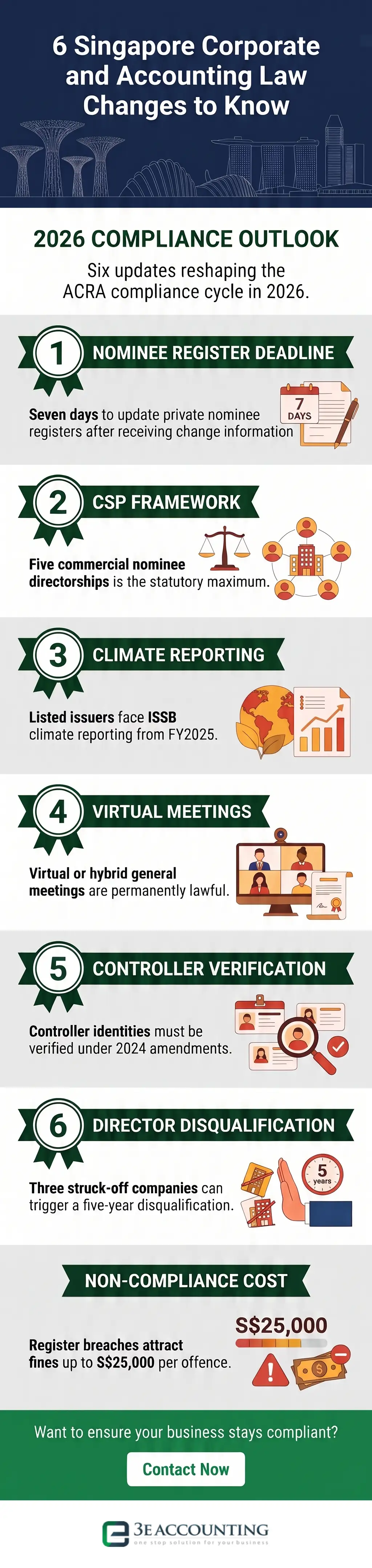
Seven days is how long companies have to update private nominee registers after receiving information about a change, unless exempt. They must update the Accounting and Corporate Regulatory Authority (ACRA) central registers within two business days of updating their private registers. The private registers support beneficial ownership transparency and must be produced to the Accounting and Corporate Regulatory Authority on request. Stale nominee disclosures can create compliance gaps. Reviewing registers before filing helps businesses keep up with Singapore corporate law changes.
What Is the Corporate Service Provider Framework?
9 June 2025 marked the start of the Corporate Service Providers Act 2024. The regime requires corporate service providers to register with ACRA and meet anti-money-laundering duties. Breaches of those duties can draw fines of up to S$100,000 per breach. Commercial nominee director appointments generally require arrangement by registered providers, which assess nominees as fit and proper. Before engaging an intermediary, businesses should confirm its registration status. Unregistered providers risk enforcement action and reputational damage.
Who Must Prepare Mandatory Climate Reports?
From FY2025, all SGX-listed issuers must report Scope 1 and 2 greenhouse gas emissions, while STI constituents must also report other ISSB-based climate disclosures. From FY2030, large non-listed companies with annual revenue of at least S$1 billion and total assets of at least S$500 million must report ISSB-based climate disclosures, unless exempt. Boards should begin collecting emissions and governance data now, because credible sustainability reporting depends on information trails built well before each filing deadline. Early preparation also keeps future expansion funding options open.
Virtual General Meetings
Singapore companies may hold fully virtual or hybrid general meetings under provisions effective from 1 July 2023. The provisions generally allow this without amending the constitution, subject to the constitution and applicable regulations. Among successive companies act amendments, this one cuts costs most directly for multinationals coordinating shareholders across time zones. Technology must still let members speak, vote and be identified throughout.
Selected compliance dates and penalties
| Requirement | Date or penalty |
|---|---|
| Corporate Service Providers Act commencement | 9 June 2025 |
| Certain statutory register breaches | Fine of up to S$25,000 per offence |
Beneficial Ownership Registers
Since 16 June 2025, applicable Singapore rules require annual verification of registrable controller particulars. The Companies and Limited Liability Partnerships (Miscellaneous Amendments) Act 2024 introduced this requirement. Unless exempt, foreign companies must also file controller information in ACRA's central register. Checking controller details rather than relying only on shareholder lists helps prevent gaps.
Director Disqualification Powers
Five years is the window in which three or more companies struck off by ACRA can trigger a director's disqualification. A first disqualification lasts three years after the third strike-off; a repeat disqualification lasts five years. ACRA may also debar directors for filing failures. Disqualification is visible to banks, investors and counterparties conducting due diligence. Directors should clear outstanding annual returns and eXtensible Business Reporting Language (XBRL) filings promptly, because strike-offs compound once lapses accumulate.
Cost of Statutory Non-Compliance
Some statutory register breaches can attract fines of up to S$25,000 per offence in Singapore. The Companies Act also exposes officers to imprisonment for false register entries, while persistent filing defaults can lead to composition offers or court prosecution. An exempt private company in Singapore must still meet applicable register and filing requirements, although some filing exemptions may apply. For most boards, professional compliance support can cost far less than remediating a breach.
Need Help Staying Compliant in 2026?
3E Accounting Singapore keeps registers, filings and board reporting aligned with the latest Singapore company law updates. Speak to our team today.
Frequently Asked Questions
Unless exempt, companies must update their private nominee registers within seven days of receiving information about a change. They must update ACRA's central registers within two business days of updating the private registers.
There is no statutory maximum of five nominee directorships. Individuals acting as nominee directors by way of business generally need appointments arranged by a registered corporate service provider, unless they are registered providers themselves.
All SGX-listed companies report Scope 1 and 2 emissions from FY2025. Other ISSB-based disclosures are phased in by listed-company tier. Large non-listed companies meeting the revenue and asset thresholds report from FY2027 unless exempt.
Yes. Since 1 July 2023, the law has generally allowed virtual and hybrid meetings without amending the constitution, subject to the constitution and applicable regulations.
A director can be disqualified when ACRA strikes off three or more of their companies within five years. A first disqualification lasts three years after the third strike-off; a repeat disqualification lasts five years. ACRA may also debar directors for filing failures.

Abigail Yu
Director
Abigail Yu oversees executive leadership at 3E Accounting Group, leading operations, IT solutions, public relations, and digital marketing to drive business success. She holds an honors degree in Communication and New Media from the National University of Singapore and is highly skilled in crisis management, financial communication, and corporate communications.