
A rejected registration does not stop the compliance clock. When a Work Permit holder changes address in Singapore, the employer must inform the Ministry of Manpower (MOM) within five days of the actual move — even where a landlord's block caused the rejection.
In this blog, we discuss why MOM's address-update system rejects some registrations, which errors point to an owner-side block, who may lawfully amend the record, and the steps our work-pass team recommends when a landlord refuses to cooperate.
Why Is a Work Permit Address Registration Blocked in Singapore?
Some rejections concern an owner-side block: the address is blocked for foreign-worker registration, and the property owner must provide consent through MOM's owner-facing service.
An update for an existing non-domestic Work Permit holder is submitted through MOM's Online Foreign Workers Address Service (OFWAS). When the system rejects an address, the message on screen matters more than the tenancy paperwork. For private residential property, a block that traces back to the owner is resolved from the owner's side through the Foreign Worker Tenant Enquiry Service (FWTES). A foreign property owner who cannot use the owner service may instead request MOM's assistance, through the route MOM has published for private residential property.
The owner's consent is only one hurdle. Housing eligibility depends on the worker and the accommodation type. MOM's housing guidance applies different Housing and Development Board (HDB) rules by nationality and sector, and eligibility for private residential property is a different test. An owner's consent alone cannot make an ineligible address lawful. System acceptance confirms registration, not necessarily housing eligibility.
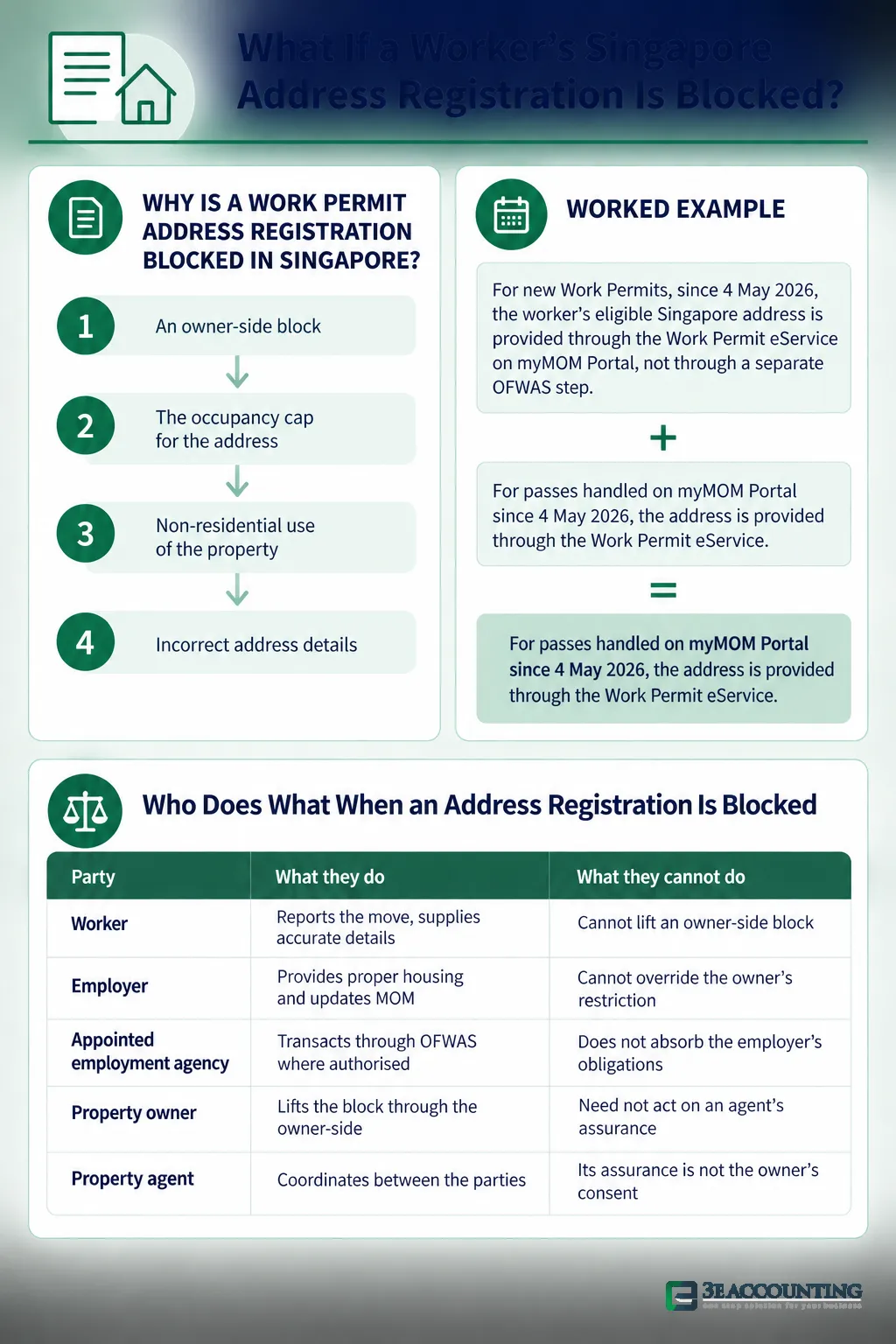
1. An owner-side block
The owner may have stopped registrations after problems with earlier occupants. Neither the employer nor an appointed agency can override the restriction. The fix is the owner's to make, and it should be confirmed before the worker moves in.
2. The occupancy cap for the address
An address may register only a set number of tenants. Where former occupants remain on the record, their removal may clear the cap. Where a higher cap has been approved, that documentation may be needed.
3. Non-residential use of the property
Where the system says an address is not approved for residential use, submit a reclassification request if the employer has documents showing that the premises are approved for residential use. Relabelling the declared use is not a quick fix.
4. Incorrect address details
A wrong unit number or postal code produces a failure that looks like a block. Verify the full unit address against the tenancy documents before assuming the owner is responsible.
What Are the Employer's Obligations When a Work Permit Holder Moves House?
The employer must provide acceptable accommodation and update MOM within five days of an existing non-domestic Work Permit holder's move. The worker, in turn, must tell the employer before moving.
According to the Ministry of Manpower (MOM), an employer must provide proper housing and update a non-domestic Work Permit holder's changed residential address within five days of the move. The clock starts at the actual move, not at the discovery of a block. A landlord dispute or an unanswered enquiry does not by itself extend the deadline. An employer facing a blocked update should seek case-specific directions from MOM rather than assume more time.
MOM's work permit conditions also require the worker to inform the employer of a planned move. HR should record when that notification arrived, but the employer's five-day window runs from the actual move. Domestic workers fall under different conditions; this workflow should not be generalised to them.
Two neighbouring routes deserve separate treatment. For new Work Permits, since 4 May 2026, the worker's eligible Singapore address is provided through the Work Permit eService on myMOM Portal, not through a separate OFWAS step. For an S Pass holder, MOM routes the employer's contact-detail update through the Employment Pass (EP) eService instead. Neither the deadline nor the owner-block sequence should be transplanted to an S Pass case without checking the applicable rules.
Employers can compare related duties in our human resource and immigration resources.
1. Provide acceptable housing at all times
The duty to house the worker properly continues throughout the pass, not only at application. A rejected address update does not suspend it.
2. Update the changed address within five days
The update must reflect the address where the worker actually lives. Recording a different address to satisfy the system is not compliance.
3. Expect the worker to report the move
The worker supplies accurate information and the relevant tenancy documents. Where a worker moves without notice, the employer should still correct the record promptly.
Common Address Registration Blocks and First Responses
| Rejection cause | What it means | First response |
|---|---|---|
| Owner-side block | The owner has stopped foreign-worker registrations at the address | Owner lifts the block through the owner service; overseas owners may seek MOM assistance |
| Occupancy cap reached | The address holds its maximum registered tenants | Remove former tenants still on record, or produce approved cap documentation |
| Non-residential use classification | The system flags the address as not approved for residential use; this does not establish its actual approval status | Follow the separate request route in MOM's guidance; do not relabel the use |
| Address entry error | Wrong unit number or postal code | Correct the details and resubmit |
| Ineligible accommodation | The housing type does not suit that worker or sector | Source acceptable alternative accommodation before the move |
Who Can Update a Foreign Worker's Address in Singapore?
For an existing non-domestic Work Permit holder, the employer's authorised user — or an employment agency authorised to transact for the employer — submits the change through OFWAS. Appointing an agency does not transfer the employer's own responsibilities.
OFWAS access requires the relevant account and permissions. Authorisation to submit is therefore not the same thing as being the responsible party. MOM's guidance assigns the housing and update duties to the employer, and separately permits an authorised agency to transact for the employer. Our reading, as an interpretation of that guidance, is that an agency's involvement is transactional help: the employer remains answerable for the outcome.
Each declaration also has its own signatory. Only the person identified in a particular declaration should make it. Check the requirements and signatory for each declaration in the actual transaction. A property agent needs actual authority to act for the owner. An authorisation letter does not substitute for a required licence or portal permission, and a client's shared login credentials should never be used.
1. The employer's authorised user
The employer's appointed portal user makes the submission and retains the acknowledgement. Responsibility for timeliness stays with the employer.
2. The appointed employment agency
An agency may transact only where it is appointed and authorised for that transaction. Its involvement does not move the underlying obligation off the employer.
3. The property owner
An owner-controlled block is lifted only from the owner's side. Neither the employer nor an agency can override it, however urgent the move.
4. The worker
The worker lives at the address given, reports the move immediately and hands over the tenancy documents. Permit records are updated through the employer-side route described here.
What Should HR Check First When the Update Is Rejected?
Before responding, HR should establish four facts: the actual move date, the full unit address, the accommodation's eligibility for that worker, and the exact rejection message.
Our team recommends establishing these facts before escalation; this sequence is a practical recommendation rather than a MOM-mandated order. The exact error decides the route: an owner-side block, an occupancy cap, a use restriction and a data-entry mistake each lead somewhere different. A tenancy agreement or a property agent's assurance is not proof that an address can be registered. Only the system's acceptance is.
Where in-house teams handle work passes occasionally, embedding this checklist into onboarding or refresher structured training for staff in Singapore helps prevent misdiagnosis.
Step 1: Confirm the actual move date
The five-day window runs from the move itself. Establish the date from the worker and the tenancy start before anything else.
Step 2: Verify the full unit address
Check the unit number and postal code against the executed tenancy. A one-character error can mimic a block.
Step 3: Check housing eligibility for that worker
Eligibility depends on nationality, sector and property type. Confirm the accommodation is acceptable for that particular worker before pursuing the owner.
Step 4: Capture the exact error message
Screenshot the rejection, wording included. The message determines whether the fix is owner-side consent, cap clearance, a use-related request or a corrected resubmission.
Who Does What When an Address Registration Is Blocked
| Party | What they do | What they cannot do |
|---|---|---|
| Worker | Reports the move, supplies accurate details and tenancy documents | Cannot lift an owner-side block |
| Employer | Provides proper housing and updates MOM within five days of the move | Cannot override the owner's restriction |
| Appointed employment agency | Transacts through OFWAS where authorised for the employer | Does not absorb the employer's obligations |
| Property owner | Lifts the block through the owner-side service | Need not act on an agent's assurance |
| Property agent | Coordinates between the parties with the owner's actual authority | Its assurance is not the owner's consent |
How Should the Employer Approach the Landlord?
HR should contact the owner directly, copy the worker and the property agent where appropriate, and obtain written confirmation that the owner has acted through the owner-side service.
A clear, factual request to the owner works better than a forwarded promise from the property agent. Ask the owner to lift the block through the owner-side service, and keep the correspondence. Where a foreign property owner cannot access that service, the assistance route MOM has published for private residential property applies.
A purely hypothetical sequence shows how the pieces fit. A Work Permit holder from Malaysia in the manufacturing sector, already holding a valid pass, moved into a privately rented room. The address update was blocked because the owner had stopped further registrations after earlier problems with occupants. The property agent's assurance was not the owner's consent, and the tenancy documents did not clear the block. Approaching the owner directly, before the move, would have exposed the restriction in time.
What If the Owner Refuses to Lift the Block?
Begin arranging suitable alternative accommodation immediately, and raise the failed transaction with MOM through its official enquiry channel. Waiting for MOM to persuade an unwilling owner risks the five-day deadline.
Replacement accommodation must itself pass the eligibility tests. For a dormitory, that means the operator, the particular premises, the permitted occupancy and the worker's actual admission; a bed quotation is not proof of residence. Once the worker has genuinely moved, submit the true address through OFWAS and retain the successful acknowledgement.
The enquiry to MOM should carry the exact error message, the full address, the move date and the supporting documents. MOM should not be assumed to compel the owner, waive the deadline or approve a particular alternative. The safer course, in our judgement, is to comply on time and seek case-specific written directions.
Where internal capacity is stretched, our guide on whether a Singapore SME should hire an HR leader or outsource HR may help employers decide who owns this coordination.
1. Arrange replacement accommodation promptly
Start sourcing the moment refusal is clear. Confirm eligibility, move the worker, then update the record.
2. Raise the failed transaction with MOM
Use the official enquiry or feedback channel rather than unrestricted email, so sensitive worker information is handled properly.
3. Keep a disciplined evidence file
We recommend retaining the tenancy agreement, evidence of the agent's authority, payment receipts, owner correspondence, failed-submission screenshots, MOM references, alternative accommodation offers and the final acknowledgement.
4. If the five-day window has passed
Disclose the true chronology and correct the record promptly. Do not backdate, and do not register an address where the worker does not live. A late correction does not by itself erase the breach, which is why early escalation matters.
Recommended Records to Keep for a Blocked Address Update
| Record | Why it matters |
|---|---|
| Failed submission screenshot | Shows the exact error and its date |
| Owner correspondence | Evidences the request to lift the block |
| Tenancy agreement and payment receipts | Tie the move and payments to the address |
| MOM enquiry references | Track the official escalation |
| Alternative accommodation offers | Show prompt compliance efforts |
| Final update acknowledgement | Confirms the record was corrected |
When Does This Playbook Change for Other Passes and Properties?
Pass type, sector, nationality, property type and timing each alter the advice. The decisive question is whether the address is both eligible for that worker and genuinely occupied.
For an existing non-domestic Work Permit holder, the employer updates the address within five days; for an S Pass holder, either the employer or pass holder updates MOM within five days through EP eService. Other situations follow different routes, so the playbook should be re-checked rather than reused.
1. Work Permit versus S Pass
MOM routes an S Pass holder's contact-detail update through a different service. The Work Permit deadline and FWTES sequence do not automatically carry across.
2. HDB flats versus private residential property
HDB eligibility differs by nationality and sector. A room that is acceptable in one context may be ineligible in another.
3. Dormitories versus private rentals
Dormitory accommodation is checked at the level of operator, premises and permitted occupancy. Private rentals turn on owner consent and occupancy caps.
4. A move versus a new issuance
For passes handled on myMOM Portal since 4 May 2026, the address is provided through the Work Permit eService. In-principle approval (IPA) and arrival conditions govern that route.
Conclusion
A blocked address registration is an operational problem with a compliance deadline attached. The employer's task is to diagnose the exact error, secure owner-side action where that is the cause, keep housing compliant in the meantime, and leave a truthful record with MOM.
Our team at 3E Accounting Singapore recommends reviewing the rejection, mapping the five-day window, checking accommodation documents, preparing a factual enquiry to MOM and tracking the corrected update. Submission is made by the employer's authorised user or an employment agency authorised to transact for the employer, subject to the required access. Confirm any support and transaction permissions with our team before proceeding.
If a worker's address registration has been blocked, raise it with our corporate services team early. The earlier the diagnosis, the easier it is to stay inside the deadline.
Resolve a Blocked Address Update
Speak with our corporate services team about diagnosing the rejection, coordinating with the owner and preparing the documentation MOM expects.
Frequently Asked Questions
MOM requires the employer of a non-domestic Work Permit holder to update the changed residential address within five days of the actual move. The clock runs from the move itself, and a landlord dispute does not extend it.
For an existing non-domestic Work Permit holder, the employer's authorised user or an employment agency authorised to transact for the employer can submit the change, subject to the required account and access permissions.
Confirm the exact error, ask the owner to lift the block through the owner-side service, and if the owner refuses, arrange eligible alternative accommodation and raise the failed transaction with MOM. Do not backdate or register an address where the worker does not live.
No. A tenancy agreement or a property agent's assurance is not clearance. Only successful acceptance within MOM's system confirms that the address is registered for that worker.
No. MOM lists a different service for an S Pass holder's contact-detail updates, so the Work Permit deadline and owner-block sequence should be re-checked before they are applied.

Abigail Yu
Director
Abigail Yu oversees executive leadership at 3E Accounting Group, leading operations, IT solutions, public relations, and digital marketing to drive business success. She holds an honors degree in Communication and New Media from the National University of Singapore and is highly skilled in crisis management, financial communication, and corporate communications.