
Can a Singapore company whose shareholders all sit overseas still obtain a Certificate of Residence? Yes, but IRAS looks at where control and management is exercised, not registration.
In this article, we explain why Singapore COR foreign-owned holding company applications depend on where control and management is exercised. We also cover foreign-owned investment holding companies, evidence of genuine Singapore management and nominee arrangements. Finally, we identify the records that a Certificate of Residence (COR) readiness file should contain before the 2026 filing season.
How does IRAS determine the tax residence of a Singapore holding company?
Tax residence follows where control and management is exercised. The facts can change from one year to the next.
Under IRAS guidance, a company is Singapore tax resident if control and management of its business is exercised in Singapore. The test applies to the relevant year. Control and management means decisions on strategic matters, such as investments, financing and dividend policy. It does not mean routine administration.
Incorporating a company in Singapore is not, by itself, indicative of tax residence. This matters for foreign-owned holding companies. They are often incorporated locally but directed from abroad. The assessment is factual, and a company's residence status can change from year to year as its decision-making moves.
IRAS expressly lists several factors it considers when locating control and management. These factors include:
- whether board meetings are held in Singapore
- whether strategic decisions are made here
- where the directors are located
- whether the local director makes strategic decisions
- whether key employees are based in Singapore
These are listed factors, not an exhaustive or mechanically weighted checklist.
For telephone or video meetings, IRAS generally applies two location conditions. One is that at least half of directors with authority to make strategic decisions are physically in Singapore. The other is that the board chair is physically in Singapore.
The word 'generally' matters. The broader factual test still applies. Singapore meetings alone may not be sufficient in some scenarios. IRAS considers all the facts. A Singapore board meeting should never be presented as a safe harbour or automatic proof of residence.
When is a foreign-owned investment holding company ineligible for a COR?
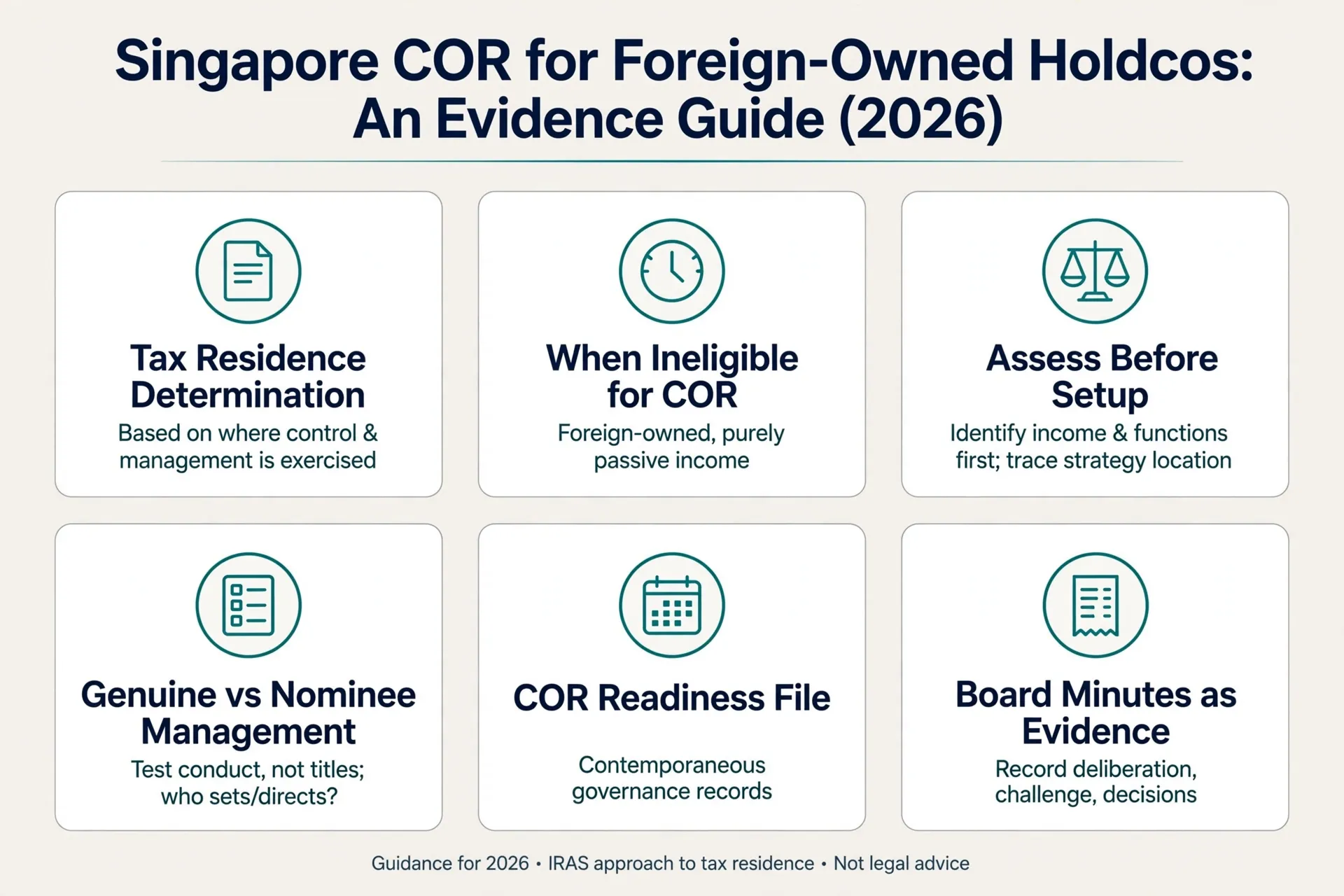
Foreign-owned investment holding companies with purely passive income or only foreign-sourced income are generally not treated as Singapore tax resident. They are generally ineligible for a COR, although IRAS publishes an exception for companies that can prove genuine substance.
IRAS applies a specific ownership test before the special rules for investment holding companies are engaged. Where that test is met, the company's income profile and functions determine the position. They decide whether the general exclusion applies and whether any exception can be made out.
1. The foreign-owned ownership test
An investment holding company is foreign-owned where 50% or more of its shares are ultimately held by foreign-incorporated companies. It is also foreign-owned where those shares are held by individuals who are not Singapore citizens. IRAS applies the test at the ultimate holding-company level, so intermediate Singapore entities do not change the analysis. Ownership tracing therefore has to reach the top of the corporate chain before the foreign-owned label is accepted.
2. The passive-income position
IRAS takes this view where a foreign-owned investment holding company derives purely passive income. The same applies where the company earns only foreign-sourced income. Such companies generally act on the instructions of their foreign shareholders. They are generally not considered Singapore tax resident and are generally not eligible for a COR. The qualification 'generally' is deliberate. It is not an absolute bar. The published exception below exists for companies whose facts differ from the passive profile.
3. The published exception and its conditions
IRAS may still issue a COR to a foreign-owned investment holding company. The company must show that control and management is exercised in Singapore. It must also show valid reasons for setting up an office in Singapore. Both conditions must be made out; satisfying only one is not enough.
To substantiate a genuine commercial reason for operating in Singapore, IRAS lists three alternatives. The company must have either a Singapore-based executive, non-nominee director; a Singapore-based key employee; or management by a Singapore-related company. These are IRAS's published substantiation routes, and they sit alongside — not instead of — the separate control-and-management condition.
One further exclusion applies to nominee companies. IRAS defines a nominee company as one that acts as a custodian of shares for beneficial owners. It is not eligible for a COR because it is not the beneficial owner of income from the treaty partner. This defined term should not be conflated with every company that merely has a nominee resident director. That is a different and more nuanced question.
Holding Company Scenarios and COR Position
| Scenario | Typical features | Position on a COR application |
|---|---|---|
| Passive investment holding company | Receives dividends, interest or disposal proceeds; no employees; decisions made overseas | Generally not Singapore tax resident; IRAS generally will not issue a COR |
| Operating holdco or regional headquarters | Supervises subsidiaries, approves budgets and acquisitions, employs decision-makers in Singapore | Can qualify where records show Singapore control and management and valid commercial reasons |
| Singapore-managed group company | Fully foreign-owned but board deliberates and decides locally | Can qualify if decisions are genuinely made, not merely implemented, in Singapore |
| Nominee company | Acts as custodian of shares for beneficial owners | Not eligible for a COR under IRAS guidance |
How should a foreign-owned holding company be assessed before applying?
Identify the income and functions first. Then trace where strategic decision-making actually occurs for the year the certificate would cover.
A COR application for a Singapore holding company whose shareholders all sit overseas is among the more difficult applications to evidence. The first-pass assessment separates four distinct scenarios, because each leads to a different recommendation.
A passive investment holding company merely receives dividends, interest or disposal proceeds. It typically has no employees and no active regional function. Where its investment, financing and distribution decisions are made overseas, a COR application is not advisable. A Singapore registered office and a resident director do not change that.
An operating holding company or regional headquarters is different. It may supervise subsidiaries, approve budgets and acquisitions, and provide treasury or management services. It may employ decision-makers and bear real commercial risks in Singapore. That profile can support an application, provided the evidence matches the description.
A Singapore-managed group company can also qualify despite complete foreign ownership. Its board must genuinely make strategic decisions in Singapore rather than simply implement parent instructions. Suitably qualified Singapore-based decision-makers, supported where appropriate by independent director services, are often central to making that profile credible.
Where a client should not apply, the honest advice is to fix the structure prospectively, not retrospectively. The essential changes are:
- defining genuine board authority
- appointing qualified Singapore-based decision-makers
- holding properly constituted meetings in Singapore
- giving the board complete information
- documenting independent consideration
It also means confirming that a COR is actually required for the relevant foreign income or treaty claim. It is not a general corporate credential.
What signals separate genuine Singapore management from a nominee arrangement?
Test conduct, not titles. Check who sets the agenda, who challenges proposals, and who can say no to the overseas shareholder.
A genuine Singapore executive director normally receives information before the meeting, participates substantively in discussion and remains involved between meetings. A nominee director usually receives a completed resolution to sign. They have little knowledge of the subsidiaries or transactions. They do not control the bank account and cannot explain why a decision was commercially appropriate.
The practical assessment reconciles the paper trail with conduct. That means checking who chairs board meetings. It means checking who approves investments, borrowing, guarantees and dividend policy. It also means asking whether the local director could realistically decline a parent proposal. Minutes are then tested against several records:
- directors' physical locations
- attendance records
- travel patterns
- email trails
- board packs
- bank mandates
- contract execution records
- delegated-authority schedules
Certain patterns make an application difficult to sustain. Common examples include:
- all commercial negotiations completed overseas before a Singapore 'approval' is recorded
- unanimous written resolutions initiated and circulated by the foreign parent
- minutes recording a Singapore meeting while the decisive directors joined from abroad
- a local director whose signature appears only on annual returns, accounts and bank forms
- foreign executives holding sole bank and contractual authority
- identical minutes repeated each quarter with no substantive deliberation
- a short meeting arranged by the corporate secretary. Its only business is to note decisions already made by the parent
These patterns can weaken the factual basis for an application. Where the contemporaneous facts do not support Singapore control and management, the better course is to withdraw or defer the application. Do not try to improve the wording retrospectively.
Conduct Signals: Genuine Executive Versus Nominee Arrangement
| Signal | Genuine Singapore executive | Nominee-style arrangement |
|---|---|---|
| Agenda and chairing | Sets or shapes the agenda; chairs or actively steers discussion | Receives a completed resolution to sign |
| Pre-meeting involvement | Reviews board packs in advance and engages with the substance | Has little knowledge of subsidiaries or transactions |
| Decision authority | Can challenge and decline proposals from the overseas shareholder | Cannot explain why a decision was commercially appropriate |
| Bank and contracts | Named on mandates; authorised within delegated limits | No control of bank accounts or major contracts |
| Between meetings | Remains involved in implementation and monitoring | Engages only for statutory filings and signatures |
What should a COR readiness file contain?
A suggested framework of contemporaneous governance records — not a published IRAS checklist — assembled before the application is lodged.
IRAS identifies the factual issues it will examine but does not publish a complete attachment checklist for foreign-owned holding companies. The framework below is a reasoned readiness approach based on those factual issues, rather than an IRAS-required document list. Treat it as a suggested starting point rather than a mandatory document list.
1. Constitutional and ownership records
The Accounting and Corporate Regulatory Authority (ACRA) business profile, constitution and registers establish the legal structure. They also show the directors in office. A complete ownership chart traced to the ultimate beneficial owners shows the foreign ownership profile. It also shows the related entities in the group. These records anchor the application in verifiable facts.
2. Governance and meeting records
Annual board calendars and meeting notices show that meetings were planned rather than staged for the application. Agendas and board packs identify the strategic matters put before directors. Signed minutes record deliberation, questions, alternatives and decisions. Attendance sheets and videoconference records establish each participant's physical location and capacity. Directors' travel evidence supports this where location is material. Written resolutions, including who initiated and circulated them, complete the governance picture.
3. Commercial, financial and reconciliation records
Budgets, forecasts, investment papers and management accounts show what the board actually considered. Delegation and reserved-matters schedules distinguish board authority from shareholder rights. Additional records may include:
- Employment or service agreements for Singapore executives
- Bank mandates and major contract signature records
- Financing and dividend papers
- Intercompany service agreements
- Financial statements and tax filings
These records are then reconciled against email trails and transaction dates to confirm that they reflect reality.
How do board minutes evidence strategic decision-making rather than routine administration?
Minutes that record deliberation, challenge and bounded authorisation are stronger evidence than minutes that merely note filings and approvals.
This is a reasoned comparison rather than an IRAS-prescribed standard. The examples below are hypothetical illustrations. They are not approved wording or a guarantee of any outcome.
A hypothetical strategic minute might read: 'The directors considered management's Singapore-prepared evaluation. It covered the proposed acquisition of Subsidiary A, including valuation scenarios, funding alternatives and regulatory risk. Ms B challenged the forecast assumptions and requested a downside sensitivity. After reviewing the revised analysis, the board rejected debt option 1. It approved option 2 subject to a stated price ceiling. It authorised two named executives to negotiate within those limits.'
By contrast, a routine-administration minute may simply record the accounts and authorise statutory filings. That corporate housekeeping can be valid, but it says little about where strategic control and management was exercised.
One principle is non-negotiable: governance records must be contemporaneous and accurate. Records should never be created, recreated or embellished solely to support a COR application. We frame this as a professional integrity and record-accuracy principle for boards and advisers alike. It is not a quoted IRAS rule.
How is a COR application filed, and what does the certificate actually prove?
Applications are generally filed through myTax Portal, and IRAS processes these applications within 14 working days of receiving the application.
IRAS publishes defined application windows. A company may apply for the current calendar year. It may apply for up to four prior calendar years. It may apply for one advance calendar year from October. Because application administration may change, the live portal and the IRAS page should be rechecked immediately before filing.
IRAS states that it processes a COR application within 14 working days after receiving complete information. Complex cases may take longer, so planning should allow for supplementary questions rather than assume the shortest timeline.
What the certificate proves is narrower than many applicants assume. A COR certifies Singapore tax residence for the relevant purpose and calendar year. It is granted for a calendar year only where control and management is exercised in Singapore in that year. It is not, by itself, a determination of every condition for foreign treaty benefits. Some treaty claims also require a tax reclaim form. Others require satisfaction of an additional Limitation of Relief condition in the treaty itself.
As a general caution, foreign withholding agents or tax authorities may require evidence beyond a Singapore COR. This may include beneficial ownership, substance or anti-abuse analysis. Whether income is retained and deployed by the Singapore company, or routinely passed upstream, may also matter. This is relevant to beneficial ownership analysis. It is a separate question from Singapore tax residence. The relevant treaty, income type and foreign procedure should be checked before an application strategy is settled.
COR Application Windows and Processing
| Application type | Period covered | Key notes |
|---|---|---|
| Current-year application | The current calendar year | Granted only where control and management is exercised in Singapore in that year |
| Back-year application | Up to four prior calendar years | Often used to support reclaims of over-withheld foreign tax |
| Advance application | One calendar year ahead, from October | Available before the year of income begins |
| Processing standard | 7 working days | Counted from receipt of the application |
Conclusion
Foreign ownership does not disqualify a Singapore holding company from a Certificate of Residence. But it does place the burden of proof squarely on evidence. IRAS looks past the registered office to where strategic decisions are genuinely made. Foreign-owned investment holding companies with purely passive or foreign-sourced income are generally ineligible.
The work therefore starts well before the application:
- clarifying income and functions
- confirming where control and management is exercised
- substantiating a valid commercial reason for Singapore operations
- assembling contemporaneous governance records that withstand scrutiny
3E Accounting Singapore advises foreign-owned holding companies on tax residence, COR applications and governance structuring. We focus on the facts and records relevant to the IRAS test. Speak to our team about your position before the relevant calendar year closes.
Prepare Your COR Evidence With 3E Accounting Singapore
Our team assesses holding company structures, advises on the IRAS evidence requirements and prepares COR applications through myTax Portal. Discuss your company's position with us before you file.
Frequently Asked Questions
Yes, in principle. IRAS may issue a COR where the company exercises control and management in Singapore. It must also show valid reasons for setting up an office in Singapore. This means one of the following:
– a Singapore-based executive non-nominee director
– a Singapore-based key employee
– management by a Singapore-related company
Usually relevant, but not automatically sufficient. IRAS says the location of board meetings where strategic decisions are made will usually determine control and management. It still considers all facts. Singapore meetings may not be sufficient in some scenarios. For virtual meetings, IRAS generally looks for at least half the strategic directors to be physically in Singapore. The board chair may also satisfy this.
IRAS defines a nominee company as one that acts as a custodian of shares for the beneficial owners. Such a company is not eligible for a COR. It is not the beneficial owner of the income from the treaty partner. This is distinct from a company that merely has a nominee resident director, which raises its own evidential weaknesses.
IRAS publishes a processing standard of 14 working days after it receives complete information. Processing may take longer for complex cases. Applicants should also recheck the live myTax Portal and IRAS page before filing, as application administration may change.
No. A COR certifies Singapore tax residence for the relevant purpose and calendar year only. Some treaty claims additionally require a tax reclaim form or satisfaction of a Limitation of Relief condition. Foreign withholding agents may request further evidence on beneficial ownership or substance.

Abigail Yu
Director
Abigail Yu oversees executive leadership at 3E Accounting Group, leading operations, IT solutions, public relations, and digital marketing to drive business success. She holds an honors degree in Communication and New Media from the National University of Singapore and is highly skilled in crisis management, financial communication, and corporate communications.