Owning foreign shares does not itself prevent IRAS dormant treatment, and some 2025 incorporations do not need to file. Corporate returns for 2026 are generally due by 30 November unless IRAS has granted a waiver.
In this article, we explain the separate dormancy tests used by ACRA and IRAS. We then cover foreign shares, unpaid dividends, idle bank accounts and waiver conditions, and set out the filings that continue even when a holding company is dormant.
What Does Dormant Mean for a Singapore Holding Company in 2026?
Dormancy is assessed separately by ACRA and IRAS under different legislation, and satisfying one test does not establish the result under the other.
Dormancy in Singapore is not a single status. The Accounting and Corporate Regulatory Authority (ACRA) administers the Companies Act 1967. It assesses whether a company qualifies for the section 201A financial-statement exemption as a dormant relevant company. The Inland Revenue Authority of Singapore (IRAS) administers corporate income tax under the Income Tax Act 1947. It asks whether the company carried on business or received income during the whole basis period. A basis period is the financial period relevant to a Year of Assessment (YA).
A Singapore holding company may be dormant under IRAS but fail ACRA's exemption. The regimes test different things. ACRA looks at accounting transactions recorded in the financial statements. IRAS looks at business activity and income. Companies should never assume that one regulator's conclusion carries over to the other.
The stakes are time-bound. For YA 2026, companies generally must file the Corporate Income Tax Return by 30 November 2026. An IRAS waiver removes this requirement. Companies incorporated in 2025 need not file if they did not close their first accounts that year. They also need not file if they closed their first accounts without starting business or receiving income in 2025. Late filing or non-filing can attract penalties of up to S$5,000. Directors remain responsible for timely, accurate filing even where an agent is engaged.
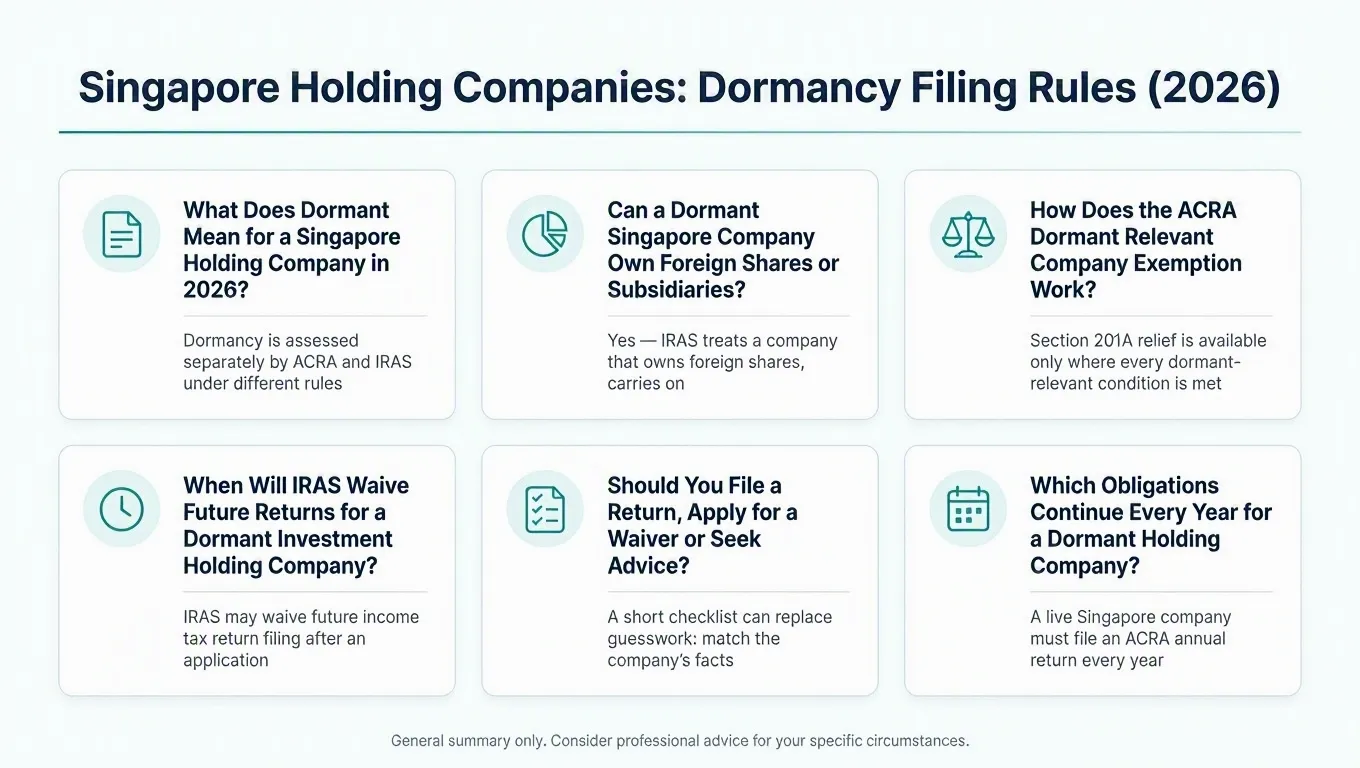
Yes — IRAS treats a company that owns foreign shares, carries on no business and derives no income from its investments as dormant, provided those conditions hold for the entire basis period.
IRAS publishes a worked example of this situation. A Singapore company holding foreign shares, with no business activity or investment income, is dormant for corporate income tax purposes. Dormant status does not remove the filing duty: unless a waiver applies, the company must still submit the Form for Dormant Company, which requires only two essential declarations, by 30 November.
The question arises frequently in practice. Many regional structures begin with incorporating a Singapore company as an investment vehicle, and the pattern is common among multinational companies establishing a Singapore holding entity for cross-border ownership. How each investment fact plays out depends on the regime and the year concerned. Where an outcome is fact-dependent, the position should be treated as requiring technical review rather than a fixed result.
1. Foreign Shares With No Income or Activity
Shares acquired before the relevant financial year do not, by themselves, prove or disprove ACRA dormancy. This is a fact-dependent analytical starting point. For IRAS, a company holding foreign shares may be dormant: it must carry on no business and have no investment income throughout the basis period. Before reaching an ACRA conclusion, confirm the investment accounting, any remeasurement and all entries for the financial year.
2. A Dividend Declared but Unpaid
A declared but unpaid dividend is not a settled matter. The analysis turns on the governing resolution, the company's legal entitlement, when the income is recognised in the accounts, and whether the income has been received in Singapore for tax purposes. Because these variables differ case by case, the prudent course is to file the appropriate return rather than assume a waiver position survives.
3. A Dividend Actually Received
Receipt of a dividend is income, so the company is not dormant for that basis period. Foreign-sourced income is generally taxable when remitted to and received in Singapore, although IRAS sets out exemption conditions for qualifying foreign-sourced dividends received by Singapore tax-resident companies. Whether an exemption or treaty relief applies requires specialist review of residence, beneficial ownership and withholding tax in the source jurisdiction.
4. Interest on an Idle Bank Account
IRAS is explicit that a company which received interest income from an investment during the financial year is not regarded as dormant for that YA. The amount is irrelevant; the legal test is the receipt of income. Even a few dollars of bank interest ends dormant treatment for the year.
5. An Unchanged Intercompany Loan Balance
A loan balance that sits unchanged and accrues no interest does not necessarily decide the year by itself. Any repayment, set-off, waiver, interest accrual or foreign-exchange remeasurement is an accounting entry that requires technical sign-off before any dormancy conclusion is reached. ACRA does not publish a transaction-by-transaction matrix, so significance and timing must be assessed for each entry.
How Does the ACRA Dormant Relevant Company Exemption Work?
Section 201A relief is available only where every dormant-relevant-company condition is met, and the test centres on whether there were significant accounting transactions during the relevant period.
ACRA applies cumulative conditions. The company must be dormant from formation or since the end of the previous financial year. It must not be listed or a subsidiary of a listed company. Total assets must not exceed S$500,000 at any time during the financial year. For a parent company, the consolidated group must meet the same threshold.
Certain prescribed transactions do not break dormancy. They include appointing a company secretary, maintaining the registered office and registers, paying statutory fees or penalties, and taking subscriber shares. The exception is narrow. ACRA asks whether significant accounting transactions affected the financial statements. Each entry needs technical accounting and corporate-secretarial sign-off before relief is claimed. Examples include a dividend receivable, interest accrual, fair-value posting or remeasurement. Significance and timing must be assessed. This is a fact-dependent judgement, not a transaction-by-transaction rule.
ACRA and IRAS Dormancy Tests Compared
| Aspect | ACRA position | IRAS position |
|---|---|---|
| Legal basis | Companies Act 1967, section 201A | Income Tax Act 1947, administered by IRAS |
| Core question | Were there significant accounting transactions affecting the financial statements? | Did the company carry on business or receive income during the whole basis period? |
| Effect of holding foreign shares | No automatic result; asset test and current-year entries still apply | Dormant possible if no business and no investment income |
| Effect of bank interest | An accounting transaction requiring assessment | Company is not dormant for that YA, whatever the amount |
| Outcome if test met | Exemption from filing financial statements with ACRA | Eligible to apply for a waiver from future income tax returns |
When Will IRAS Waive Future Returns for a Dormant Investment Holding Company?
IRAS may waive future income tax return filing after an application and assessment of every qualifying condition. Approval is never automatic.
The waiver is an application-based concession for companies that have not commenced, or have ceased, business. IRAS assesses the application against the company's facts, so approval is not automatic. Where IRAS has issued a return for the year, the company should file it, and it should also file the applicable return if income arose or the facts remain uncertain. The applicable return may be Form C-S, Form C-S (Lite) or Form C.
Once IRAS grants a waiver, the company must notify IRAS within one month if it recommences business or begins receiving income, and request the appropriate corporate return at that point. A one-off income receipt has a specific IRAS process and should not be treated as automatically preserving the waiver.
1. No Income From Investments
The company must not derive income from the investments it holds, including interest or dividends, during the relevant period. Ownership of the investments alone is not the obstacle; income from them is.
2. Tax Affairs Fully Up to Date
All required returns, financial statements and tax computations up to the cessation date must be filed. For advance YAs, IRAS gives the company 21 days from the waiver application to file them.
3. GST Registration Cancelled
A company that was previously registered for Goods and Services Tax must have cancelled that registration before applying for the waiver.
4. No Restart Within Two Years
The company must not intend to recommence business within the next two years.
Should You File a Return, Apply for a Waiver or Seek Advice?
A short checklist can replace guesswork: match the company's facts to one of three practical routes before each filing deadline.
Where the position is uncertain, a structured decision checklist helps convert the caveats into action:
- Confirm no income and no non-prescribed accounting transactions for the whole basis period and financial year — review bank statements, investment statements, dividend resolutions and intercompany confirmations.
- If income arose or a return has already been issued, file the appropriate return by 30 November.
Choose Form C-S, Form C-S (Lite), Form C or the Form for Dormant Company, as applicable.
- If the company is dormant, tax affairs are up to date, GST registration is cancelled and no restart is planned within two years, apply for the IRAS waiver of future returns.
- If a dividend has been declared but not paid, an intercompany movement occurred, or a remeasurement entry was posted, obtain technical accounting and tax review before claiming relief or a waiver.
- Diarise the ACRA annual return and continuing secretarial obligations, which apply regardless of the tax outcome.
Holding-Company Fact Patterns and Their Filing Consequences
| Fact pattern | IRAS position | ACRA position | Practical action |
|---|---|---|---|
| Foreign shares held, no income, no current-year transactions | Dormant; waiver may be available | Relief possible if asset test met | File Form for Dormant Company unless waiver granted |
| Dividend declared by subsidiary but unpaid | Fact-dependent analysis required | Recognition may end relief | File the appropriate return; assess receipt separately |
| Dividend actually received | Not dormant | Relief ends | File a return; review exemption conditions |
| Interest received on an idle bank account | Not dormant for that YA | Accounting transaction recorded | File a return |
| Unchanged non-interest-bearing intercompany loan | Generally fact-dependent | Fact-dependent | Confirm current-year entries before concluding |
| Live GST registration | Waiver unavailable until deregistration | No direct effect on the ACRA test | File nil GST returns; cancel registration first |
Which Obligations Continue Every Year for a Dormant Holding Company?
A live Singapore company must file an ACRA annual return every year, including when dormant or holding an IRAS waiver. A non-listed company normally files within seven months after its financial year end.
A common and costly misconception is that an IRAS waiver switches off all filings. ACRA requires every live Singapore company to file an annual return; this includes dormant companies and companies with an IRAS waiver. For a non-listed company with a 31 December 2025 financial year end, the deadline is 31 July 2026. A company with share capital and an overseas branch register has eight months instead of seven, and entity-specific circumstances can alter the timing.
Businesses should diary both the ACRA and IRAS dates at the start of 2026. A missed annual return remains a compliance event regardless of tax status.
1. The ACRA Annual Return
The annual return is filed through ACRA's systems and is entirely separate from any tax waiver. Solvent exempt private companies without a corporate shareholder are generally exempt from filing financial statements with ACRA, though they must still prepare and circulate them.
2. AGM Exemption and Member Rights
An eligible private dormant relevant company may be exempt from holding an annual general meeting. AGM details are still declared in the annual return, and members retain statutory rights to requisition a meeting. The exemption wording is specific and should not be read as covering all dormant companies.
3. Registered Office, Secretary and Registers
Dormancy does not dissolve the company. A Singapore registered office address, a company secretary, accounting records and the applicable statutory registers must be maintained, including registrable-controller obligations, subject to their own exemptions and deadlines.
How Does GST Registration Affect a Dormant Company in Singapore?
GST registration does not determine ACRA dormancy. A GST-registered company must keep filing GST returns, including nil returns, until cancellation takes effect, and live GST registration is inconsistent with the IRAS waiver conditions.
IRAS requires a GST-registered person to continue meeting its GST obligations up to the last registration day, filing nil returns where there are no business transactions. For a dormant holding company, the practical sequence is to cancel GST registration first, then apply for the IRAS dormant-company waiver. The two regimes are otherwise independent: a company is not non-dormant for ACRA purposes merely because it is, or was, GST-registered.
Cancellation itself needs care. IRAS's final return process (Form GST F8) can require output tax to be accounted for on specified business assets where their aggregate open-market value exceeds S$10,000. That rule applies to the official asset categories and exceptions, so retained investments are not automatically deemed supplies. Test the company's facts against IRAS's published conditions before finalising deregistration.
Conclusion
Dormancy for a Singapore holding company is a two-regime exercise, not a single badge. IRAS can treat a company holding foreign shares as dormant if it carries on no business and receives no income. Unless IRAS grants a waiver, the company must file the Form for Dormant Company or another appropriate corporate return. ACRA relief depends on significant accounting transactions, the S$500,000 company or group asset test and no listing connection. Declared but unpaid dividends, bank interest and intercompany movements require fact-specific review rather than assumption.
Even with an IRAS waiver, a company retains an annual compliance calendar. It must file the ACRA annual return within seven months after the financial year end and maintain its registered office, company secretary and applicable registers. GST returns continue until cancellation takes effect. When business recommences or income begins, a waived company must notify IRAS within one month.
A company can be dormant under one regime but not the other, and the difference only becomes visible when the facts are checked line by line. We help holding companies assess dormancy, prepare IRAS waiver applications, keep ACRA annual filings on track and manage GST deregistration. Review the company's position with our team well before the 30 November 2026 deadline.
Review Your Holding Company's Dormancy Position
Our corporate services team assesses ACRA and IRAS dormancy, prepares waiver applications and keeps annual filings on track.
Frequently Asked Questions
Yes, for IRAS purposes, provided it carried on no business and received no income — including dividends or interest — during the whole basis period. ACRA financial-statement relief is a separate test based on significant accounting transactions, listing status and the S$500,000 company or group asset threshold.
There is no universal answer. The outcome depends on the governing resolution, the company's legal entitlement, when the income is recognised in the accounts and whether it has been received in Singapore for tax purposes. The prudent course is to file the appropriate return rather than assume a waiver continues.
Yes. IRAS regards a company that received interest income from an investment during the financial year as not dormant for that Year of Assessment. The amount is irrelevant; the legal test is the receipt of income.
No. ACRA requires all live Singapore companies, including dormant companies and companies with an IRAS waiver, to file an annual return. A non-listed company normally files within seven months after its financial year end.
Yes. A GST-registered company must continue filing returns, including nil returns, until its cancellation takes effect. GST registration must be cancelled before applying for the IRAS dormant-company waiver, and the final return may involve output tax on specified business assets above the S$10,000 open-market-value threshold.

Abigail Yu
Director
Abigail Yu oversees executive leadership at 3E Accounting Group, leading operations, IT solutions, public relations, and digital marketing to drive business success. She holds an honors degree in Communication and New Media from the National University of Singapore and is highly skilled in crisis management, financial communication, and corporate communications.