
A Singapore-incorporated company is not automatically a Singapore tax resident. For Singapore company tax residency, remote founders must show where control and management is genuinely exercised.
This 2026 guide examines whether a remotely managed, foreign-owned Singapore company can obtain tax residence and a COR. In this blog, we discuss IRAS's control-and-management test and virtual board meetings. We also cover nominee-director arrangements, foreign-owned holding companies, timing and an illustrative readiness framework. For a focused walkthrough, see our Singapore COR for foreign-owned holdcos: an evidence guide 2026.
Singapore company tax residency remote founders: What does IRAS test?
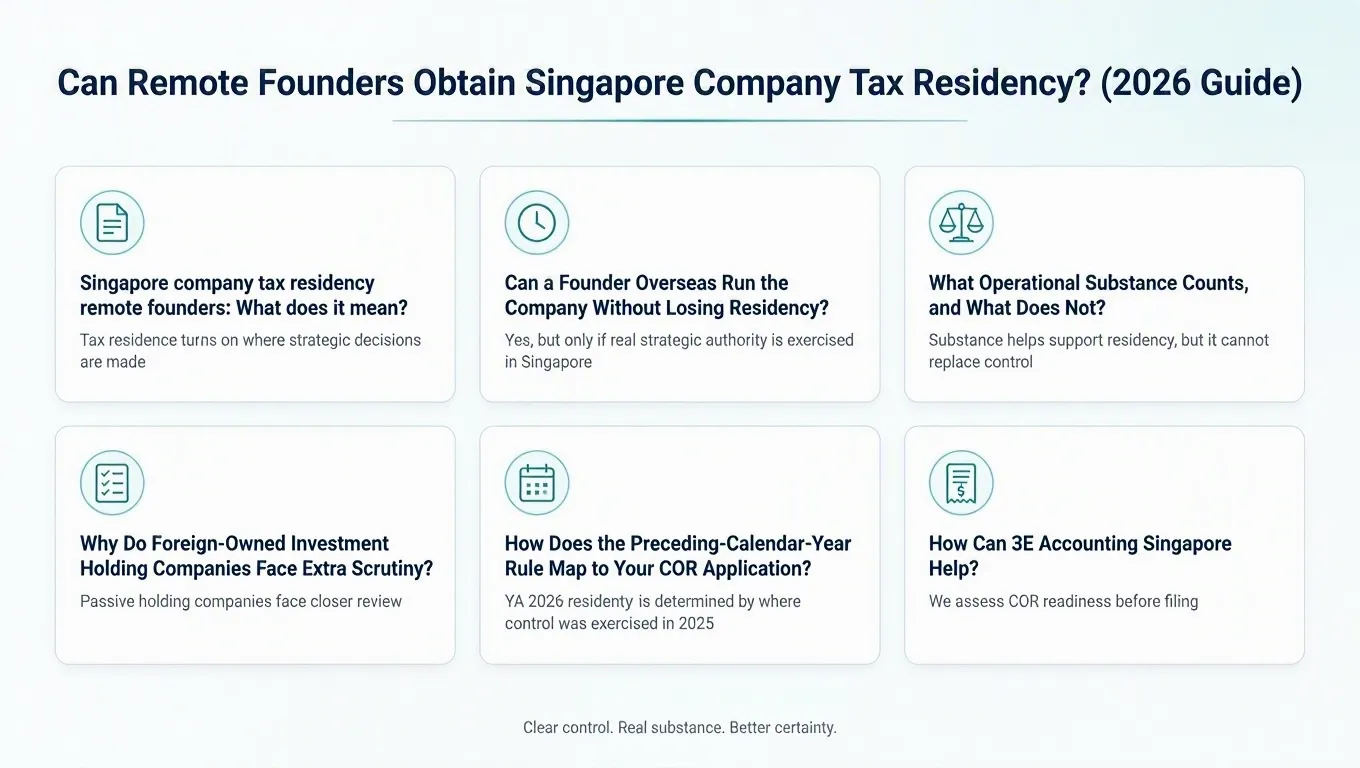
Singapore tax residence turns on where strategic decisions are made, not where the company is registered or administered.
IRAS applies a single, fact-based test: a company is resident in Singapore for a Year of Assessment (YA) if its control and management is exercised in Singapore during the relevant period. Control and management refers to the making of decisions on strategic matters — the class of choices that shape the company's direction, such as approving budgets, material contracts, senior appointments, financing and distributions. Incorporation in Singapore, a local registered office, a Singapore bank account and the routine conduct of bookkeeping or secretarial administration are not, by themselves, indicative of tax residence. IRAS considers the full facts of each company, so no single document or address is decisive.
In practice, the usual determinant is where the board of directors meets to make those strategic decisions. That is the starting point of the analysis, not the end of it. Singapore board meetings do not settle the analysis. IRAS may find control and management is exercised elsewhere when overseas parties make the substantive decisions. Those parties may include founders, a parent company or an investment manager. The test is about genuine authority and genuine deliberation, which is why remotely managed companies require careful evidence rather than a paper trail of signed resolutions.
Can a Founder Overseas Run the Company Without Losing Residence?
Yes, but only if the people with real strategic authority exercise that authority from Singapore — remote founders who merely retain veto rights abroad put residence at risk.
The Companies Act 1967, administered by the Accounting and Corporate Regulatory Authority (ACRA), requires every Singapore-incorporated company to have at least one director who is ordinarily resident in Singapore. That is a company-law requirement. It does not, by itself, establish Singapore tax residence, and founders should not treat the appointment of a locally resident director as a tax-residency solution.
For virtual board meetings, IRAS generally treats strategic decisions as made in Singapore if either condition below is met:
- At least 50 per cent of directors with strategic authority are physically in Singapore.
- The board chair is physically in Singapore. Two cautions follow. First, the word 'generally' matters — IRAS may consider all the facts. Second, the directors counted must actually hold authority to make strategic decisions; a director who signs pre-agreed documents does not qualify.
Our tax team's review of remotely managed companies focuses on one question above all others: did the Singapore-based decision-makers possess real authority? Contemporaneous meeting records, email trails, delegated-authority documents and the timing of signatures tell that story far more reliably than job titles or a registered-office address. The following three patterns illustrate how the analysis differs.
1. Nominee Local Director With Founders Abroad
Here the founders and substantive decision-makers are overseas, while a Singapore-resident nominee director exists solely to satisfy the Companies Act requirement. A nominee who signs documents only after receiving overseas instructions, under a nominee agreement that reserves strategic matters to the founders, does not demonstrate Singapore control and management on those facts. Note that a company cannot lawfully have every director resident abroad, so an 'all directors abroad' scenario in reality means all real decision-makers are abroad while a local director holds office in name.
2. Local Director on Paper Without Genuine Authority
Typical warning signs include template unanimous resolutions, no recorded deliberation, approvals circulated from overseas, and contracts already agreed before the Singapore director signs. Where the local director merely ratifies, the substance of the decision remains overseas, and the residence position follows the substance. This is an interpretive application of the IRAS strategic-decision test rather than a published IRAS rule, but it is the pattern an experienced practitioner looks at first.
3. Singapore Executive With Genuine Authority
A Singapore-based executive director or senior employee may genuinely develop proposals and control budgets and banking. They may also negotiate material contracts and participate in substantive board meetings held in Singapore. In that case, the residence position is materially stronger. The distinguishing evidence is contemporaneous: meeting records, travel and attendance logs, email trails, employment records, payment approvals and signature timing.
Residence Factors Remote Founders Must Know (2026)
| Factor | Effect on Singapore Tax Residence | Notes |
|---|---|---|
| Incorporation and registered office in Singapore | Not decisive | Incorporation is not necessarily indicative of tax residence |
| At least one ordinarily resident director | Not decisive | A Companies Act 1967 requirement, not a tax-residency solution |
| Board meetings in Singapore | Primary indicator | Usual determinant, but insufficient if strategic decisions are made elsewhere |
| Virtual meetings with 50% of strategic directors physically in Singapore | Generally accepted | Applies where those directors hold real strategic authority, or the chair is physically in Singapore |
| Local employees, premises, payroll and bank operation | Supportive corroboration | Cannot cure offshore strategic control |
| Nominee director acting on overseas instructions | Undermines residence | Strategic control remains with overseas instructers |
What Operational Substance Counts, and What Does Not?
Singapore operational substance is relevant corroboration, but it cannot replace the control-and-management test.
IRAS considers Singapore board meetings, strategic decisions made by the local director and key employees in Singapore. These factors can corroborate local management. Local key employees, premises, payroll and bank operation may explain why the company exists in Singapore. They cannot, on their own, cure offshore strategic control.
A company can have strong operating substance but weak control-and-management evidence. That risk arises where overseas founders still approve:
- Annual budgets
- Material contracts
- Borrowing
- Senior appointments
- Distributions
An illustrative readiness framework can examine decision authority, board papers and minutes, meeting attendance and physical locations. It can also examine travel evidence, delegated authorities and contemporaneous communications. The purpose is to test whether Singapore-based decision-makers exercised real strategic authority during the relevant calendar year. It is not a prescribed IRAS checklist, and no single document is decisive.
Suggested examples of contemporaneous evidence include:
- Banking: board minutes approving facilities, signatories or material borrowing.
- Contracts: a board paper and minutes approving final commercial terms.
- Key executives: board or committee minutes approving appointment, remuneration and delegated powers.
- Treasury and distributions: a board resolution with a supporting treasury paper.
Why Do Foreign-Owned Investment Holding Companies Face Extra Scrutiny?
A foreign-owned passive investment holding company with only foreign-sourced or passive income is generally not considered Singapore tax resident, subject to published exceptions.
IRAS treats foreign-owned investment holding companies with purely passive or only foreign-sourced income as generally not Singapore tax resident. This applies where they act on the instructions of foreign shareholders or a foreign parent. Many remote founders use a Singapore holding entity for dividends, interest or asset ownership. An overseas manager selects the investments, financing and dividend amounts. A local bank account, registered office and corporate-secretarial records do not alter where control is exercised.
IRAS may still issue a COR if the company demonstrates Singapore control and management. It must have a valid reason for a Singapore office. It must also satisfy at least one published substance condition:
- At least one Singapore-based director holds an executive position and is not a nominee director.
- At least one key employee is based in Singapore.
- A related Singapore company manages the company.
These alternatives are specific to the investment holding context. They should not be recast as a universal checklist for all foreign-owned operating companies.
The contrast with a genuine operating company is instructive. An operating company with Singapore customers, employees, premises, payroll and local supplier activity can explain why it exists in Singapore. A passive holding entity cannot do this as credibly. Yet even there, overseas founders may still retain approval over budgets, material contracts, borrowing, senior appointments and distributions. The residence position becomes supportable only after the board and Singapore executives receive and exercise genuine authority over those matters. This contrast is a general professional assessment. Each company's prospects depend on its own facts.
COR Application Timeline for Remote Founders
| Item | Calendar Year 2025 / YA 2026 Position | Guidance |
|---|---|---|
| Management window for YA 2026 | 1 January – 31 December 2025 | Window is closed; evidence must relate to this period |
| Newly incorporated company | Incorporation date – 31 December 2025 | No evidence can predate the company's existence |
| Online COR applications available from September 2026 | Calendar years 2022–2026 | Calendar year 2027 opens from October 2026 |
| Founder relocates or holds Singapore board meeting in 2026 | Supports YA 2027, not YA 2026 | Conduct in 2026 maps to the 2026 management window |
| Application where 2025 decisions were made overseas | Premature on those facts | Consider deferring and building prospective evidence |
How Does the Preceding-Calendar-Year Rule Map to Your COR Application?
For YA 2026, Singapore tax residence is generally determined by where control and management was exercised during calendar year 2025 — a window that has already closed.
A company's residence for a YA is generally based on the preceding calendar year. Residence for YA 2026 therefore depends on control and management exercised between 1 January and 31 December 2025, and a COR requested for the 2025 income period needs evidence supporting the residence position corresponding to YA 2026. For a newly incorporated company, the examination runs from incorporation to 31 December, not before the company existed.
As of September 2026, IRAS's online COR application service permits applications for calendar years 2022 through 2026, and an application for calendar year 2027 may be made from October 2026. Portal availability, however, is not evidence of residence: IRAS grants a COR only if the company exercised control and management in Singapore throughout the specified calendar year.
The most common sequencing error among remote founders is to relocate a founder or hold a Singapore board meeting in 2026 and rely on it for YA 2026. Conduct in 2026 generally supports the 2026 management window and hence YA 2027 — not the already-closed 2025 window. Our team's general risk-management view is that deferral may be more responsible after an overseas decision-making period closes. This is an interpretation, not an IRAS rule. The company can then build genuine prospective evidence for a later period. An unsupported claim can create inconsistencies with corporate tax returns and treaty positions.
Suggested Contemporaneous Records for Strategic Decisions
| Strategic Decision | Suggested Record (Illustrative, Not IRAS-Mandated) |
|---|---|
| Banking facilities, signatories and material borrowing | Board minutes approving the banking relationship and facilities, showing meeting location and reasoning |
| Material customer, supplier or licensing contracts | Board paper and attached minutes approving the final commercial terms |
| Appointment or removal of key executives | Board or committee minutes approving the appointment, remuneration and delegated powers |
| Treasury, cash pooling, investments and dividends | Contemporaneous board resolution with supporting treasury paper |
How Can 3E Accounting Singapore Help?
We assess COR readiness before anything is filed, so remote founders know their position before relying on treaty relief.
Our tax team reviews governance documents, board records and operating substance against the IRAS control-and-management test. We advise whether a COR application is supportable for the relevant calendar year. We also advise whether the structure first needs genuine governance change. We flag a case for specialist tax or legal advice before any application is made where it suggests:
- dual residence
- a foreign permanent establishment
- treaty tie-breaker issues
- inconsistent tax filings
- nominee arrangements that restrict independent judgment
We do not recommend filing merely to see whether IRAS accepts it. Founders planning a new structure can read about company formation options in Singapore. Individuals relocating here should review the Singapore personal income tax rates that will apply to them.
Conclusion
Singapore company tax residency for remote founders is achievable. It is earned through genuine decision-making in Singapore during the relevant calendar year. It is not earned through a local address, a nominee director or a set of signed resolutions. The IRAS control-and-management test, the virtual-meeting conditions, the investment holding company rules and the preceding-calendar-year timeline form a framework. That framework rewards real governance and punishes paper arrangements.
For foreign founders operating through a Singapore company, first establish the calendar-year window at stake. Then test whether Singapore-based decision-makers held and exercised genuine strategic authority during that window. Only then should the company file a COR application supported by contemporaneous records. Where the window has already closed with decisions made overseas, deferral is usually the more responsible route. Then the company can reset governance for the next period.
3E Accounting Singapore helps remotely managed and foreign-owned companies with this analysis end to end. We cover governance and readiness reviews, COR applications and ongoing corporate tax compliance. Contact our team to review your company's position before treaty relief or a COR claim is relied upon.
Review Your Company's Residency Position Before You Apply
Our corporate tax team can assess your company's control-and-management evidence for the relevant calendar year and advise on the responsible timing of a Certificate of Residence application.
Frequently Asked Questions
No. Under the IRAS control-and-management test, tax residence depends on where strategic decisions are made. Incorporation, a registered office and local administration are not necessarily indicative of tax residence, and IRAS considers the full facts of each company.
No. At least one ordinarily resident director is a company-law requirement under ACRA, but it does not itself establish tax residence. A nominee director who only signs pre-agreed documents on overseas instructions is unlikely to demonstrate Singapore control and management.
IRAS generally treats strategic decisions made through virtual meetings as made in Singapore if at least 50 per cent of directors with strategic authority are physically in Singapore, or the board chair is physically in Singapore. The directors counted must hold real authority to make strategic decisions.
Generally, a foreign-owned investment holding company with purely passive or only foreign-sourced income that acts on foreign shareholder instructions is not considered Singapore tax resident. IRAS may issue a COR where the company shows Singapore control and management, a valid reason for a Singapore office, and at least one of the published substance conditions.
From September 2026, online applications are available for calendar years 2022 through 2026, and calendar year 2027 opens from October 2026. Note that for YA 2026, residence depends on control and management exercised during calendar year 2025, so your evidence must match the year you apply for.

Abigail Yu
Director
Abigail Yu oversees executive leadership at 3E Accounting Group, leading operations, IT solutions, public relations, and digital marketing to drive business success. She holds an honors degree in Communication and New Media from the National University of Singapore and is highly skilled in crisis management, financial communication, and corporate communications.