

What Do the ACRA 2026 Amendments Mean for Singapore Directors?
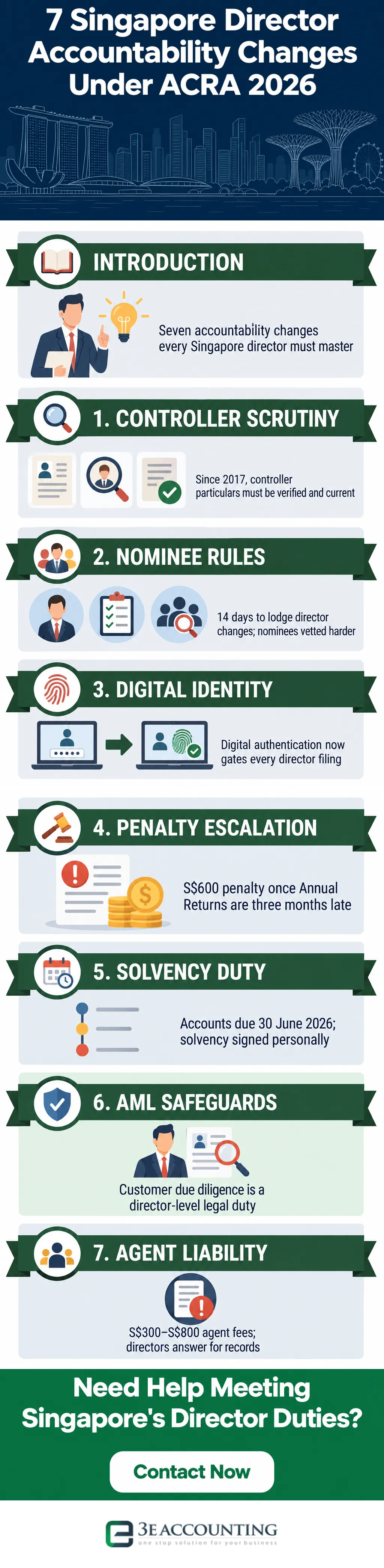
S$600 is the penalty a company attracts once its Annual Return is more than three months late under section 197(8) of the Companies Act 1967. That figure frames the ACRA 2026 amendments: director accountability in Singapore is being tightened across beneficial ownership, nominee arrangements, digital identity and statutory filings. The Accounting and Corporate Regulatory Authority (ACRA) now expects boards to treat governance as an active, evidenced duty. Governance is no longer an administrative formality. Directors who grasp all seven changes early protect themselves from fines, disqualification and reputational damage. In this infographic, we set out the seven pivotal changes every Singapore director must master in 2026.
How Has ACRA Heightened Beneficial Ownership Scrutiny in 2026?
Singapore's registrable controller regime has applied since 31 March 2017. Unless the company is exempt, directors must verify the identification particulars of its registrable controllers. They must also keep those particulars current in the Register of Registrable Controllers. Gaps between a company's register and ACRA's central register of registrable controllers are readily surfaced in the regulator's compliance reviews. Stale or incomplete controller data invites enforcement action against the responsible officers. Boards should run a verification calendar and retain evidence of each check, so their filings withstand regulatory scrutiny.
Why Have Nominee Director Regulations Become Stricter in 2026?
For local companies, changes to director particulars must be lodged with ACRA within 14 days, with 30 days allowed for foreign companies registered in Singapore. Nominee arrangements now attract elevated fit-and-proper criteria and heightened personal responsibility, as ACRA targets inactive or dummy directorships across Singapore. Nominees who fail to discharge genuine duties face removal and enforcement, and the companies behind them face disruption. Boards relying on nominee structures should review each appointment and document active engagement.
Why Is Digital Identity Verification Now Mandatory for Directors?
Director-related filings on BizFile+ now require digital identity authentication by the person transacting. Appointed directors and authorised personnel must complete secure verification before ACRA accepts the filing. This is done through Singapore's authorised national digital systems, such as Singpass and Corppass. The measure is designed to block corporate identity fraud and ghost directorships. Boards should confirm each director holds an active digital credential well before statutory deadlines. Failed authentication is no defence for late lodgment.
What Non-Compliance Penalties Do Directors Face Under ACRA 2026?
Late Annual Return lodgment now costs S$600 once three months overdue. A S$300 late lodgment penalty applies if the return is filed late within three months of the due date. This rises to S$600 beyond three months under section 197(8) of the Companies Act 1967. ACRA may also pursue composition sums or prosecution against officers in default. For a 31 December 2025 financial year end, the deadline is 31 July 2026, and IRAS dates follow separately.
Key Compliance Deadlines and Penalties for a 31 December 2025 Financial Year End
| Compliance item | Requirement or penalty | Timing |
|---|---|---|
| Changes to director particulars | Must be lodged with ACRA | Within 14 days |
| Annual Return filed within 3 months of due date | S$300 penalty under section 197(8) | After the due date |
| Annual Return filed beyond 3 months | S$600 penalty under section 197(8) | More than 3 months overdue |
| Financial statements | Must be tabled by the board | By 30 June 2026 |
| Annual Return | Filed with ACRA | By 31 July 2026 |
| Corporate income tax return | Filed with IRAS | By 30 November 2026 |
| Registered filing agent fees | S$300 to S$800 for incorporation work | At incorporation |
How Has Oversight on Solvency Declarations Tightened in 2026?
Accounts for a 31 December 2025 year end must be tabled at the AGM by 30 June 2026. This applies where the company is required to hold one. Companies not required to hold an AGM must send their accounts to members. The deadline is five months from the financial year end. That deadline anchors expanded board accountability: directors who sign declarations of solvency certify financial viability personally, and inaccurate certifications attract direct liability. Before approving accounts or declarations, boards should stress-test cash-flow assumptions and document the basis of their assessment. Solvency oversight is now a standing duty, not a liquidation-day formality.
How Have Anti-Money Laundering Safeguards Been Reinforced in 2026?
Directors of entities within the scope of Singapore's reinforced AML/CFT framework must implement verifiable customer due diligence. This includes entities such as licensed Corporate Service Providers. Boards of these in-scope entities can no longer outsource responsibility for knowing who their company transacts with. Suspicious corporate transactions must be escalated through the suspicious transaction reporting regime. In practice, documented due diligence workflows should be built to satisfy both ACRA expectations and banking partner requirements. We help clients build documented due diligence workflows as part of our corporate services. These workflows protect the board from facilitation risk.
Who Is Liable for Company Records Given to Filing Agents in 2026?
Registered filing agents in Singapore typically charge S$300 to S$800 for incorporation work. That relationship now cuts both ways. Directors bear direct legal liability for supplying unverified or inaccurate company records to licensed Corporate Service Providers during statutory filings. Errors in the particulars handed to an agent remain the board's responsibility. Verify data at the point of incorporation in Singapore and re-verify before every filing cycle. Before registering any new entity, also check Singapore company name availability online with ACRA.
Need Help Meeting Singapore's Director Duties?
3E Accounting supports Singapore directors with filings, registers and governance — reach out for tailored compliance support.
Frequently Asked Questions
They tighten seven areas of a Singapore director's duties: beneficial ownership scrutiny, nominee director regulations, digital identity verification, non-compliance penalties, solvency declarations, anti-money laundering safeguards and liability for records given to Corporate Service Providers.
A S$300 late lodgment penalty applies if the Annual Return is filed within three months of the due date, rising to S$600 beyond three months under section 197(8) of the Companies Act 1967.
Yes. Nominee directors face elevated fit-and-proper criteria and heightened personal responsibility, and changes to director particulars must be lodged with ACRA within 14 days for local companies.
No. Directors bear direct legal liability for supplying unverified or inaccurate company records to licensed Corporate Service Providers during statutory filings, so they must verify the data they hand over.
Financial statements must be tabled by 30 June 2026, the Annual Return filed with ACRA by 31 July 2026, and the corporate income tax return filed with IRAS by 30 November 2026.

Abigail Yu
Director
Abigail Yu oversees executive leadership at 3E Accounting Group, leading operations, IT solutions, public relations, and digital marketing to drive business success. She holds an honors degree in Communication and New Media from the National University of Singapore and is highly skilled in crisis management, financial communication, and corporate communications.