

What Six Requirements Must a New Singapore Company Meet After Incorporation?
A new Singapore company needs six essentials in place from day one. These are corporate secretarial support, banking access, a registered office, bookkeeping, tax filing and an ordinarily resident director.
Singapore ranks among the world's easiest places to start a business, placing top for business efficiency in IMD's 2026 World Competitiveness Ranking. Incorporation takes just one to two working days, but registration is only the starting line.
The moment ACRA issues your UEN, a countdown begins on multiple statutory deadlines. Missing any one of them triggers automatic fines that start at $300 and can escalate quickly. For new entrepreneurs and foreign founders especially, this countdown is easy to miss. Knowing which post incorporation services Singapore companies need protects compliance and the company's good standing.
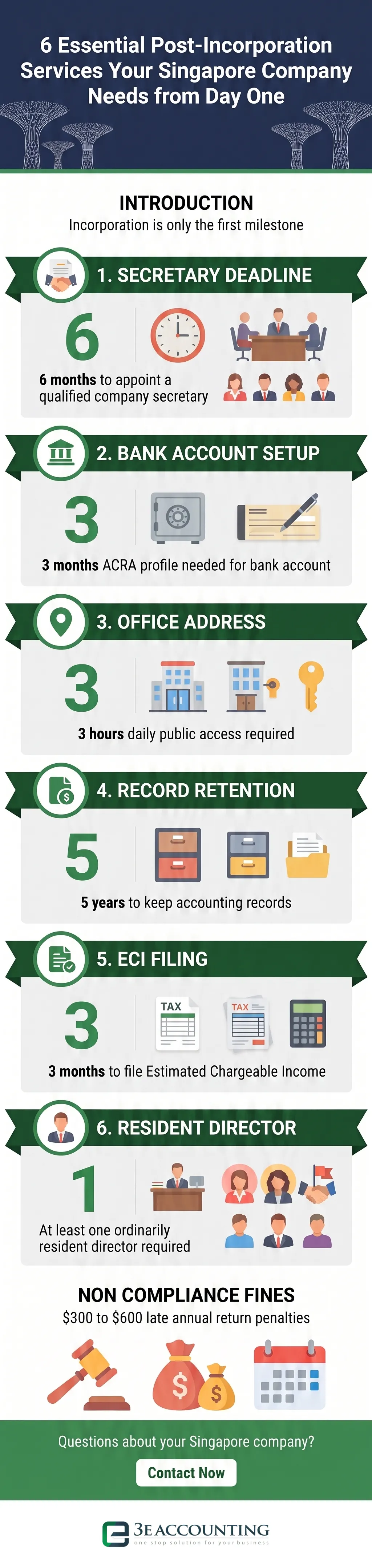
Every Singapore company must navigate six foundational requirements after incorporation:
- Corporate secretarial duties
- Banking access
- A registered office
- Bookkeeping systems
- Tax filing obligations
- An ordinarily resident director
The resident-director rule is an incorporation prerequisite that continues as an ongoing obligation. Among these, the secretary appointment, registered office and tax filings are strict statutory obligations. Banking access and bookkeeping support are operational necessities rather than statutory duties. Both can be outsourced to a professional provider for hands-on support. Each requirement carries its own timeline, cost and penalty for non-compliance. Getting them right from day one keeps cash flow moving, books in order and the business visible to clients and partners.
3E Accounting is a Corporate Services Provider that has supported more than 10,000 clients from incorporation through their first years of compliance. Our team of 120 skilled staff uses AI, automation and technology-enabled processes to track every deadline. We offer 24/7 support across time zones for global clients through our network in more than 110 countries.
In this blog, we walk through the six essential services your new Singapore company needs immediately after incorporation. We cover the statutory deadlines attached to each and how a professional provider removes the administrative burden entirely.
When Must a Singapore Company Appoint Its Corporate Secretary?
Within six months of incorporation — a vacant secretary role beyond this cap attracts a fine of up to $1,000 per director.
6 months is the maximum period ACRA allows a new Singapore company to leave the company secretary position vacant after incorporation. Directors face a fine of up to $1,000 if the post stays unfilled beyond this cap. A qualified local secretary maintains statutory registers, prepares AGMs and files timely ACRA returns. This service ensures the company stays in good standing from the very first day.
What Do Banks Require for a New Singapore Company to Open a Business Account?
Most banks require an ACRA business profile issued within the last three months; professional document assembly speeds up multi-currency account opening.
3 months is the maximum age for an ACRA business profile that most Singapore banks will accept when reviewing a new corporate account application. Professional documentation support assembles the constitution, board resolution, director IDs and proof of address. A business account can typically be opened within one to three weeks once all documents are in order. This allows cash flow to start soon after incorporation.
What Registered Office Address Requirements Apply from Day One?
Companies must keep a registered office open for at least three hours every business day. Any change must be filed with ACRA within 14 days.
3 hours of public access every business day is the minimum requirement for a registered office under ACRA rules. ACRA mandates a physical Singapore address from the date of incorporation that remains accessible to the public. Changes to the address or hours must be filed within 14 days. A professional registered office service supplies a compliant commercial location and handles all official mail.
What Record-Keeping Requirements Must a New Singapore Company Follow?
Accounting records must be kept for at least five years from the relevant Year of Assessment, following Singapore Financial Reporting Standards.
5 years is the minimum period a Singapore company must keep its accounting records, counted from the relevant Year of Assessment. Every transaction, including sales, purchases, receipts and payments, must be recorded in an orderly bookkeeping system from the date of incorporation. Supporting documents should be filed so that each entry can be traced back to its source. These include invoices, bank statements, receipts and contracts. Financial statements must also be prepared annually in accordance with Singapore Financial Reporting Standards (SFRS). Accurate records feed directly into XBRL filing with ACRA and tax submissions to IRAS, and they protect the company during any IRAS review.
Engaging post incorporation services Singapore providers to run monthly bookkeeping keeps these records complete, current and compliant from day one.
Post-Incorporation Deadlines at a Glance
| Service | Deadline / Requirement | Penalty for Non-Compliance |
|---|---|---|
| Company Secretary | Appoint within 6 months of incorporation | Up to $1,000 fine per director |
| Registered Office | Open 3+ hours each business day; file changes within 14 days | $200–$500 composition sums |
| Bookkeeping Records | Keep at least 5 years from Year of Assessment | Penalties on audit or IRAS review |
| ECI Filing | File within 3 months of financial year end | Late-filing penalties |
| Annual Returns | File within filing deadline each year | $300 (within 3 months) or $600 (after) |
| Resident Director | At least one ordinarily resident director at all times | Breach of ACRA conditions |
When Are a New Singapore Company's Tax Filing Obligations Triggered?
ECI must be filed within three months of the financial year end. GST registration becomes compulsory once taxable turnover exceeds $1 million in a 12-month period.
3 months after the financial year end is the IRAS deadline for filing the Estimated Chargeable Income (ECI) form. This makes the ECI the company's first formal tax declaration, due shortly after its first accounting period closes. Companies that meet IRAS's eligibility criteria may be exempt from ECI filing, but companies required to file must do so within this three-month window. Companies then pay corporate income tax at the prevailing 17% rate on chargeable income.
GST registration becomes compulsory once taxable turnover exceeds $1 million in a 12-month period. GST-registered businesses must also file quarterly returns. They must additionally observe InvoiceNow requirements for e-invoicing. The April 2026 mandate is being rolled out in phases. Newly incorporated companies that register for GST come under the requirement first. Existing GST-registered businesses are brought in during later phases. Engaging a professional provider early keeps ECI, income tax and GST deadlines tracked and filed on time.
Does a Singapore Company Need an Ordinarily Resident Director?
ACRA requires at least one ordinarily resident director at all times — foreign founders commonly engage a nominee director to meet this condition.
At least 1 ordinarily resident director is required under the Singapore Companies Act at all times. This is a statutory officeholder requirement that applies from incorporation onward, not a service in itself. A nominee director arrangement is an outsourced way for foreign founders to satisfy it.
A foreign founder who does not reside in Singapore can appoint a nominee director to meet this statutory ACRA condition. The nominee is a Singapore resident who satisfies all eligibility rules. The nominee remains subject to statutory director duties. These include the obligation to exercise genuine oversight of the company's affairs and compliance with Singapore regulations. While the overseas owner directs business strategy, the nominee cannot act as a mere placeholder and must ensure the company meets its legal obligations. This arrangement allows the company to be formed without the founder relocating to Singapore.
What Are the Real Costs of Missing a Post-Incorporation Deadline?
Late annual returns start at $300 within three months; amount doubles to $600 thereafter. A vacant secretary post risks a $1,000 fine.
Annual returns must be filed with ACRA within seven months of the financial year end, so this is the action date to track. Late annual returns attract ACRA penalties of $300 if filed within three months of the deadline or $600 thereafter. A vacant secretary post can result in a $1,000 fine for directors. Other late notifications carry $50 or $200 charges. Minimum composition sums of $500 apply for some breaches and repeated offences may lead to court summons or company striking-off. Prompt engagement of a corporate services provider avoids these entirely.
Ready to Protect Your New Company?
Our team handles every post-incorporation requirement so you can focus on growth.
Frequently Asked Questions
ACRA requires appointment within six months of incorporation. The post cannot stay vacant longer than six months.
Compulsory registration applies once taxable turnover exceeds $1 million under the retrospective or prospective test.
IRAS requires records to be retained for at least five years from the relevant Year of Assessment.
ACRA charges $300 if filed within three months of the deadline and $600 if later.
Yes. ACRA requires at least one ordinarily resident director at all times.

Abigail Yu
Author
Abigail Yu oversees executive leadership at 3E Accounting Group, leading operations, IT solutions, public relations, and digital marketing to drive business success. She holds an honors degree in Communication and New Media from the National University of Singapore and is highly skilled in crisis management, financial communication, and corporate communications.