
A local employee's resignation can reduce a Singapore company's foreign worker quota after the relevant CPF data is processed.
In this guide, we explain how MOM calculates the foreign worker quota and when a local resignation pulls down S Pass and Work Permit entitlements. We also explain what to do after hiring a replacement. We cover CPF timing, automatic Saturday quota updates, the consequences of a temporary breach, and how to request quota flexibility from MOM with the right supporting documents.
How Does MOM Calculate the Foreign Worker Quota in Singapore?
MOM measures quota against a rolling three-month average of qualifying local employees, not the headcount on any single day.
Under MOM's foreign worker quota guidance, a Singapore company's entitlement depends on two moving parts. The first is the foreign workers it already employs. The second is the local employees whose salary and CPF data support them. Because MOM recalculates entitlement as CPF records arrive, the impact of a resignation unfolds across several months rather than on one date.
Three building blocks drive the calculation, and each one decides whether a local resignation actually bites.
1. The sector ceilings that set the limits
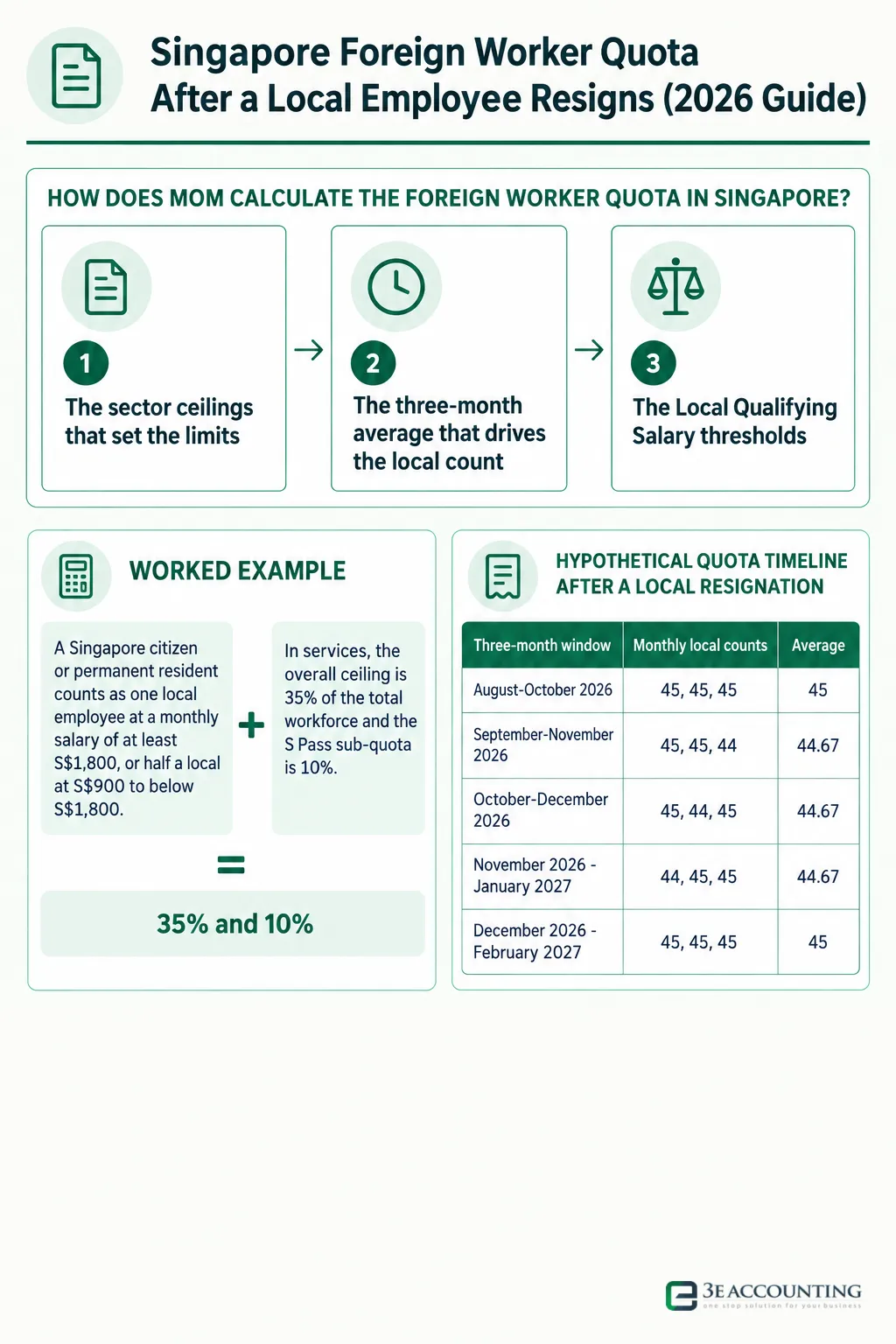
Most sectors carry two tests. The overall dependency ratio ceiling covers Work Permit and S Pass holders together, while a separate sub-quota caps S Pass holders alone. In services, the overall ceiling is 35% of the total workforce and the S Pass sub-quota is 10%. Construction, manufacturing, marine shipyard and process sectors carry a 15% S Pass sub-quota, with overall ceilings that differ again. The company's MOM sector classification controls, so confirm it before running any calculation.
2. The three-month average that drives the local count
MOM computes the local workforce from the latest three-month average of qualifying local employees, using salary and CPF data declared under the company's CPF account. Newly registered organisations with no prior CPF contributions receive a different initial allocation. This averaging window is why a resignation affects quota in stages rather than at once.
3. The Local Qualifying Salary thresholds
A Singapore citizen or permanent resident counts as one local employee at a monthly salary of at least S$1,800, or half a local at S$900 to below S$1,800. Other eligibility and CPF conditions also apply, so a job title or a full-time contract alone does not establish the count. Holders of other passes, including anyone on a Long Term Visit Pass, do not add to the local workforce.
When Could a Local Employee Resignation Cut Your S Pass Quota?
The shortfall appears when the departing employee's lower count enters the three-month average, weeks after the resignation date rather than on it.
A worked example shows the mechanics, using hypothetical figures that every employer should re-check against MOM's own calculator.
Assume a services company employs 45 qualifying local staff and five S Pass holders, with no Work Permit holders. Each local earns S$3,000 a month, receives CPF contributions and satisfies every other eligibility condition. Five S Pass holders in a 50-person workforce is exactly 10%, so the company sits at its sub-quota with nothing to spare.
Now assume one local employee resigns effective 31 October 2026, receives a qualifying October salary and CPF, and a replacement starts on 1 December 2026. The qualifying local counts run: September 45, October 45, November 44, December 45, January 45 and February 45.
The three-month averages that follow are 44.67 for the September-November, October-December and November-January windows, then 45 for December-February. At a 10% sub-quota, an average of 44.67 locals with five existing S Pass holders supports an entitlement of four, not five. The entitlement returns to five only when November's low count leaves the window. The figures and calculations are hypothetical. A practitioner must confirm them against MOM's calculator and the live quota balance.
In practice, these movements appear only after MOM receives and processes the relevant CPF records. MOM updates quota automatically on Saturdays, and its guidance indicates that an average local workforce update may take around two Saturdays after a CPF payment is received. That interval is approximate rather than a fixed processing guarantee. A December 2026 shortfall and March 2027 recovery are hypothetical planning estimates, not confirmed MOM update dates. Later contributions could delay recovery beyond March. A practitioner should confirm both estimates.
Late or incorrectly declared data can deepen the problem. MOM identifies late CPF submissions, incorrect salaries and incorrect contribution months as possible causes of a reduced local count. Late or backdated contributions may not count even after arrears are paid.
The same arithmetic explains why starting composition matters. Consider a hypothetical services company with six qualifying locals and five S Pass holders. With no other workers, its S Pass share exceeds the 10% sub-quota. A practitioner should confirm the workforce assumptions and calculation against MOM's calculator. This suggests a structural issue rather than a temporary dip. Any flexibility request is subject to MOM's assessment. Companies managing Singapore's manpower crunch often run close to their ceilings, so we treat any local resignation as the trigger for an immediate forecast.
Sector Quota Rules for 2026
| Sector | S Pass sub-quota | Overall dependency ceiling |
|---|---|---|
| Services | 10% of total workforce | 35% of total workforce |
| Construction | 15% | Sector-specific, confirm with MOM |
| Manufacturing | 15% | Sector-specific, confirm with MOM |
| Marine shipyard | 15% | Sector-specific, confirm with MOM |
| Process | 15% | Sector-specific, confirm with MOM |
What Should You Do After Hiring a Replacement Local Employee?
Confirm the CPF position first, then consider a documented flexibility request to MOM. A signed contract alone restores nothing.
A replacement hire does not re-enter the quota calculation on the day the contract is signed. What counts is the qualifying salary month supported by CPF contributions, and the point at which the deficient month leaves the rolling average.
In the hypothetical above, December 2026 is the replacement's first qualifying salary month. Even so, the December, January and February contributions are all needed before November's low count drops out of the window. In this illustration, recovery might appear around March 2027, but the estimate needs practitioner confirmation. Actual timing depends on CPF submissions and MOM's processing. A company with spare capacity or a smaller deficit may recover sooner, and a partial first month's pay may count differently under the prevailing Local Qualifying Salary rules.
Employers may also ask MOM for case-specific flexibility. In a written parliamentary answer dated 10 September 2026, MOM described an available flexibility request. After hiring a replacement, employers may ask MOM to use the latest month's local employee count. MOM assesses supporting documents, such as the replacement's employment contract and CPF contribution. A request is not an approval. The answer promises no concession, no decision deadline and no universal grace period, and MOM has separately stated that it cannot manually amend quota numbers to accommodate urgent hiring requests.
From our advisory work, the submissions that carry weight prove the dip is real and temporary. A working pack would include:
- payroll and CPF contribution records
- the resignation and final-pay documents
- the replacement's contract and commencement evidence
- a month-by-month quota reconciliation
- a schedule of affected passes and expiry dates Proof that CPF was actually paid, rather than merely accrued, matters more than any board-level letter. This is a proposed checklist, not MOM's mandatory document list. Confirm it and the submission route with the practitioner. MOM cites the replacement contract and CPF contribution as examples of supporting documents.
A flexibility request is usually wasted where there is no evidence-backed recovery plan, where the proposed local hire is not genuine, or where the strategy depends on artificial CPF contributions. Correcting an actual CPF or classification error, genuine local recruitment, a planned reduction in foreign headcount, or an alternative pass route the employee independently qualifies for are better uses of management attention.
Employers who want a second pair of eyes on the numbers can contact our team at 3E Accounting Singapore before any pass expiry intervenes. The sequence we recommend after a local resignation is as follows.
1. Reconcile payroll and CPF records
Confirm qualifying salaries, contribution months and payment status against MOM's local-employee criteria before assuming any count. The recurring failure points our team sees are contractual salary checked instead of qualifying salary, late CPF, and the wrong contribution month.
2. Fix the dates that drive the average
Establish the last working day, the final qualifying salary month, the replacement's start date and the first full qualifying month. These four dates frame the entire forecast.
3. Pull the live quota and pass-expiry schedule
Download the current entitlement and every pass's expiry date from MOM's work-pass system. Renewals depend on quota, so expiry dates set the real deadlines.
4. Hold discretionary foreign hiring
Pause new Work Permit or S Pass applications until the forecast is clear, while keeping all existing employment and CPF obligations current.
5. Submit a documented request to MOM
Where a shortfall or renewal is at risk, use MOM's online feedback and enquiry channels for work-pass matters, retain the reference number, and ask what each affected pass requires and by when. If MOM has issued a notice, follow the response route specified in that notice.
6. Monitor the automatic quota updates
Track the Saturday updates after each CPF payment and re-run the forecast as each salary month lands. Do not rely on the resignation or replacement date for timing.
Hypothetical Quota Timeline After a Local Resignation
| Three-month window | Monthly local counts | Average | Indicative S Pass entitlement |
|---|---|---|---|
| August-October 2026 | 45, 45, 45 | 45 | 5 |
| September-November 2026 | 45, 45, 44 | 44.67 | 4 |
| October-December 2026 | 45, 44, 45 | 44.67 | 4 |
| November 2026 – January 2027 | 44, 45, 45 | 44.67 | 4 |
| December 2026 – February 2027 | 45, 45, 45 | 45 | 5 |
What Happens to Existing S Pass Holders If the Quota Is Breached?
Existing passes are not cancelled on the resignation date, but an over-quota employer risks rejected renewals and, ultimately, revocation of excess passes.
A local employee's resignation does not, by itself, cancel an S Pass or Work Permit on the day it takes effect. Existing passes remain subject to their conditions and can be revoked before expiry if an excess is not resolved. What changes is the company's entitlement to hold and renew foreign workers, and that is where the exposure sits.
MOM's published guidance on quota excess is direct. New applications and renewals may be rejected while a company is over quota. Excess passes may need to be cancelled. Otherwise, MOM says it will revoke the excess passes. The company will also be barred from hiring new foreign workers for six months. An employer should follow the response route and any deadlines stated in an MOM notice. The three-month averaging mechanism is not a grace period, and no blanket cancellation deferral should be assumed.
Renewals need particular attention. An S Pass renewal requires sufficient quota under the relevant sector limits, alongside the other renewal conditions, and applications can generally be submitted up to six months before the pass expires. An existing holder does not acquire a right to renewal merely because a shortfall is temporary, and a pending flexibility request or appeal does not extend the pass.
The first document we compile for any affected employer is a schedule of every pass and its expiry. The earliest renewal, not the replacement hire's first payroll, sets the real deadline. If recovery is expected after that date, obtain MOM's written position on the specific pass beforehand. Describe an application as held pending recovery only if MOM's correspondence or the application record confirms it.
Evidence for a Quota Flexibility Request
| Document | Why it matters |
|---|---|
| Payroll and CPF contribution records | Confirms qualifying salary actually earned and declared |
| Resignation and final-pay documents | Establishes the cause and date of the dip |
| Replacement employment contract | Expressly cited by MOM as a supporting document |
| CPF payment acknowledgements | Proves contributions were paid, not merely accrued |
| Month-by-month quota reconciliation | Shows the shortfall is temporary and when it clears |
| Schedule of affected passes and expiry dates | Identifies renewals at risk during the dip |
Consequences of Exceeding the Foreign Worker Quota
| Situation | Consequence |
|---|---|
| New Work Permit or S Pass application | May be rejected while the company is over quota |
| S Pass renewal | Requires sufficient sector quota; generally submissible up to six months before expiry |
| Excess passes not resolved after MOM's notice | Excess passes revoked; company barred from hiring new foreign workers for six months |
| Pending flexibility request or appeal | Does not extend a pass or suspend a stated deadline |
When Does the Advice Change by Sector or Pass Type?
The binding limit differs by sector, and spare overall capacity never cures an S Pass sub-quota shortage.
In services, the 35% overall dependency ceiling and the 10% S Pass sub-quota operate as separate tests. Work Permit and S Pass holders both count toward the overall ratio, while only S Pass holders count toward the sub-quota. A company can therefore hold unused overall capacity and still breach the sub-quota, which is a common assumption to get wrong.
Outside services, the S Pass sub-quota is 15% in construction, manufacturing, marine shipyard and process, and the overall dependency ceilings differ again by sector. The employer's MOM sector classification controls the applicable limits, not the business description in its marketing materials. For Work Permit holders, source-country, occupation and sector conditions apply on top of any numerical quota, so entitlement alone does not settle whether a particular hire is possible.
What usually decides these cases is evidence quality rather than argument. We verify payroll and CPF acknowledgements before estimating any recovery date. We would not pursue a speculative flexibility request where the local hire is not genuine or the plan depends on artificial contributions.
Employers can bundle work-pass administration with payroll, corporate secretarial and tax filings under integrated corporate services arrangements. This can help keep CPF data consistent with forecasts and reduce the risk of late or mis-declared contributions.
Conclusion
A local resignation does not cost quota on the day it happens. The exposure can emerge as the departing employee's lower count enters MOM's three-month average. Recovery timing depends on the starting quota position, corrective actions and processing of qualifying salary and CPF data. Throughout, the S Pass sub-quota and the overall dependency ceiling remain separate tests.
Employers should reconcile payroll and CPF data immediately. Forecast the affected windows against MOM's calculator. Pause discretionary foreign hiring. Put any flexibility request in writing with the replacement contract and CPF evidence attached. Pass expiry dates, not recruitment timelines, set the real deadlines.
3E Accounting Singapore advises Singapore employers on work-pass planning, payroll and CPF administration, and corporate tax compliance. If a local resignation has put your quota position in doubt, our team can review the numbers, prepare the forecast and assemble the submission before a renewal date forces the issue.
Plan Your Quota Recovery With 3E Accounting Singapore
A local resignation need not cost your company its S Pass or Work Permit entitlement. Our team reviews CPF records, forecasts quota movement and prepares documented submissions to MOM.
Frequently Asked Questions
No. The reduction appears when the departing employee's lower count enters MOM's rolling three-month average, after the relevant salary and CPF data is processed. MOM updates quota figures automatically on Saturdays, and its guidance indicates an average local workforce update may take around two Saturdays after a CPF payment is received.
Only salary months supported by CPF contributions count. In the hypothetical example above, three qualifying salary months would push the deficient month out of the average. The projected recovery timing needs practitioner confirmation and is not an official guarantee. Other employers may recover sooner or later, depending on their starting position and corrective actions. Check the live balance in MOM's work-pass system and the online quota calculator before relying on any date.
You may request this. In a written parliamentary answer dated 10 September 2026, MOM confirmed that employers may ask for the quota to be computed using the latest month's local count, with supporting documents such as the replacement's employment contract and CPF contribution assessed case by case. A request is not an approval, and MOM separately states it cannot manually amend quota numbers to accommodate urgent hiring.
New applications and renewals may be rejected while over quota, and excess passes may need to be cancelled. MOM states that where the excess is not resolved, the excess passes will be revoked and the company barred from hiring new foreign workers for six months. Follow the response route and deadlines stated in any MOM notice.
The S Pass sub-quota is 15% in construction, manufacturing, marine shipyard and process, against 10% in services, and the overall dependency ceilings also differ. Confirm your company's MOM sector classification and the applicable Work Permit conditions rather than relying on the services example.

Abigail Yu
Director
Abigail Yu oversees executive leadership at 3E Accounting Group, leading operations, IT solutions, public relations, and digital marketing to drive business success. She holds an honors degree in Communication and New Media from the National University of Singapore and is highly skilled in crisis management, financial communication, and corporate communications.