
A resignation can be ineffective if it leaves a Singapore company without an ordinarily resident director. Replacing the only resident director in Singapore therefore requires careful sequencing, not just paperwork.
In this guide, we discuss the checks and filings our corporate secretarial team considers during a resident-director handover. We also cover Form 45, ACRA notifications, nominee registers, bank signatories and a hypothetical sequence.
Why Must a Company Replace a Resident Director in Singapore Before the Outgoing One Resigns?
A Singapore-incorporated company must keep at least one director who is ordinarily resident in Singapore, so a voluntary resignation that would leave none is not valid.
The Companies Act 1967 is administered by the Accounting and Corporate Regulatory Authority (ACRA). It requires every Singapore-incorporated company to keep at least one ordinarily resident director on its board. ACRA's guidance states that a voluntary resignation must comply with the company's constitution and leave at least one ordinarily resident director in office. A resignation letter that would leave the board with no resident member therefore does not operate as the departing director expects.
Two limits apply to this rule. This guide concerns a Singapore-incorporated company, not a foreign-company branch. The voluntary-resignation rule does not prevent death or disqualification. Later sections discuss these and other exceptional exits separately. The residence condition is not a one-off incorporation test. It is the same condition verified at ACRA company registration, and it applies for the life of the company.
1. Confirm the successor's eligibility before accepting any resignation
ACRA requires a director to satisfy age, capacity, residence and disqualification requirements. The candidate must be at least 18 years old, have full legal capacity and be eligible to act as a director, including having any required permission. Ordinary residence is assessed on the candidate's actual circumstances — a Singapore address alone is not conclusive evidence of residence.
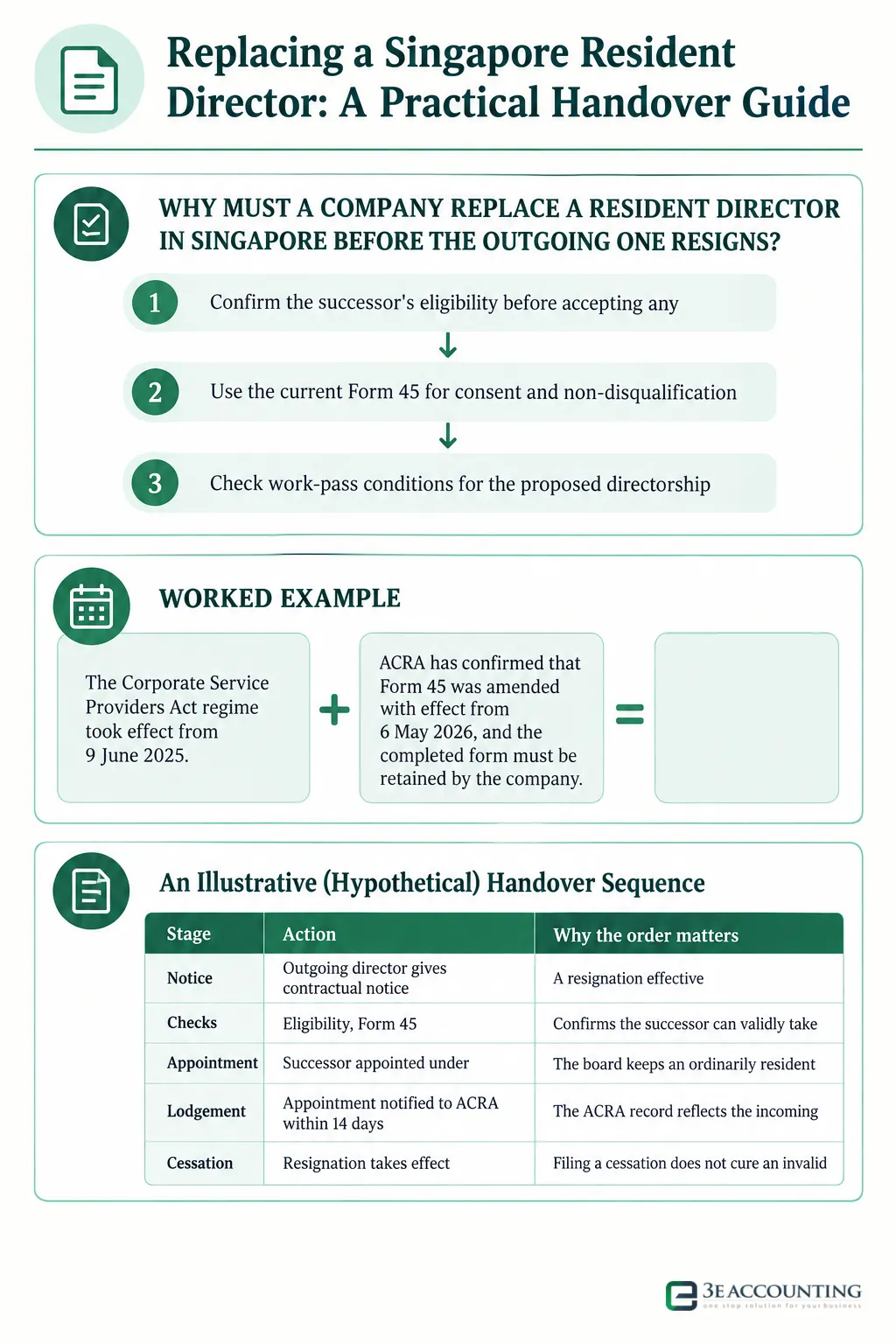
2. Use the current Form 45 for consent and non-disqualification
A new director signs the prescribed consent to act and declaration of non-disqualification on Form 45, or Form 45A where applicable permission has been granted. ACRA has confirmed that Form 45 was amended with effect from 6 May 2026, and the completed form must be retained by the company. Use the current version; older copies embedded in historical guides will not do.
3. Check work-pass conditions for the proposed directorship
Where the candidate holds a work pass, the pass conditions and any required approval must be checked first. The Ministry of Manpower (MOM) requires a Letter of Consent before an Employment Pass holder takes up a secondary directorship in another company. Requirements differ by pass and role, so each position must be assessed individually.
How Should the Appointment and Cessation Be Sequenced?
Appoint the eligible successor before the outgoing director's resignation takes effect, and notify ACRA of each change within 14 days. We recommend checking the appointment record before resignation as an additional safeguard.
ACRA identifies director appointments and resignations as matters addressed in the company's constitution. The Bizfile filing that follows is only a notification of the corporate act — it is not the appointment itself.
For the exit mechanics themselves, see our companion guide on what happens when a company director resigns in Singapore. Before filing, remember that an overseas-based director alone does not satisfy the residence requirement. Their authority and quorum position may still matter to the transition.
Step 1: Check who may appoint under the constitution
Review the actual constitution before assuming the appointment is a board decision. Quorum and any members' approval requirements must be honoured. Where the document is silent or unusual, take legal advice rather than proceed on assumption.
Step 2: Appoint the successor and verify the ACRA record
Appoint the successor first and let the appointment take effect. A local company must notify ACRA of the appointment within 14 days of the change. It must lodge the change through the Bizfile position-holder eService. It must check any required endorsements before treating the transaction as complete. Check the updated officers in the ACRA business profile. This is a recommended safeguard, not a legal prerequisite for resignation.
Step 3: Let the resignation take effect, then lodge the cessation
For a planned exit, we recommend an overlap: the successor's appointment becomes effective before the outgoing director's resignation takes effect. This is a practical safeguard, not a prescribed minimum interval. Once the resignation is effective, the cessation must be notified to ACRA within 14 days, and late lodgement attracts penalties. Uploading a cessation does not cure an invalid resignation.
Step 4: Keep the evidence of both changes
Retain the resolutions, the completed Form 45 and the Bizfile transaction records. The ACRA electronic register updates when changes are filed, so reconcile the company's own records against it. Treat this reconciliation as a handover control rather than an incidental tidy-up.
Incoming Director Checks Before Appointment
| Check | What to confirm | Common pitfall |
|---|---|---|
| Ordinary residence | The candidate is ordinarily resident in Singapore | A Singapore address alone is not conclusive evidence |
| Age and capacity | The candidate is at least 18 with full legal capacity | Overlooking a disqualification arising elsewhere |
| Disqualification status | No applicable bar to acting, or required permission obtained | Using an outdated or inappropriate consent form |
| Consent to act | Current Form 45 signed and retained by the company | Assuming consent from a verbal acceptance |
| Work-pass conditions | Any MOM approval needed for the particular directorship | Treating all passes as having the same conditions |
What Should the Resident Director Handover Checklist in Singapore Cover?
A complete handover covers statutory and nominee registers, government digital access, and a sweep of licences, contracts and passes — not just the ACRA filings.
Director changes interact with several registers and access systems, and recent reforms have made this sweep more demanding than older online guides suggest. The Corporate Service Providers Act regime took effect from 9 June 2025. It governs nominee arrangements made by way of business. The central nominee-register reporting regime followed on 16 June 2025.
We also suggest a decision-and-obligation log for the transition. It could cover:
- Pending board decisions and contracts under negotiation
- Financial and statutory deadlines, banking and tax
- Employment, licences and disputes
Give each item an owner, deadline and completion evidence. Tailor the entries to the company. Even a small exempt private company in Singapore benefits from this discipline, because its thinner governance structure leaves less margin for error.
1. Update statutory and nominee registers
Retain the appointment and cessation records alongside the completed Form 45, and reconcile them against the ACRA register. Subject to statutory exemptions, a person acting as a nominee director by way of business must either be a registered corporate service provider for the relevant service or have the role arranged by one; a provider arranging the role must assess the individual as fit and proper. Nominee information must be maintained, and ACRA's central register updated within two business days after the private register is updated, subject to exemptions. Not every resident director is a nominee, so apply the rules to the actual arrangement.
2. Reset digital access under the company's own authority
Never transfer personal credentials. Singpass advises users not to share passwords, passcodes or one-time passwords, so create or authorise individual access instead. Corppass and IRAS access should be reviewed separately during the handover. IRAS requires employees and third parties to be authorised through Corppass before they can access an entity's myTax Portal services. A director change does not automatically transfer portal permissions.
3. Sweep licences, contracts and work passes
A change of director does not automatically change registrable-controller information, because controllers are defined by significant interest or control rather than director status. Check the actual ownership and control facts, and the applicable exemptions, before updating anything. Separately, identify any licence, contract, work pass or regulated role that names the outgoing director; MOM confirms that some work-pass changes require notification. Identify the specific instrument and regulator before asserting any requirement.
An Illustrative (Hypothetical) Handover Sequence
| Stage | Action | Why the order matters |
|---|---|---|
| Notice | Outgoing director gives contractual notice; a timetable is documented | A resignation effective before a replacement is appointed would be invalid |
| Checks | Eligibility, Form 45, constitution and bank checklist reviewed | Confirms the successor can validly take office and sign |
| Appointment | Successor appointed under the constitution's process | The board keeps an ordinarily resident director at all times |
| Lodgement | Appointment notified to ACRA within 14 days | The ACRA record reflects the incoming director early |
| Cessation | Resignation takes effect; cessation notified within 14 days | Filing a cessation does not cure an invalid resignation |
| Banking | Mandate and digital access updated and tested | A filing receipt does not change the bank mandate |
How Do You Change a Company Bank Signatory in Singapore Without Disrupting Payments?
Treat the ACRA filing, the bank mandate and digital-banking permissions as three separate workstreams — and never assume a filing receipt changes the bank's records.
The ACRA record and the bank's records are independent. A filing receipt does not change the bank mandate, and a bank mandate does not update ACRA. Some banks distinguish their mandate process from their electronic-banking process, so each account's own rules are controlling. Our corporate secretarial team recommends coordinating these workstreams in parallel rather than treating them as one task.
1. Map the roles before requesting changes
A new director does not necessarily need to become an account signatory. Establish the required bank roles and signing combinations first, then request only the changes the company actually needs.
2. Follow the bank's account-specific checklist
Obtain the bank's written instructions before promising any outcome: the forms, authorisations, identity verification and any attendance or overseas-signing requirements vary by bank and account. Banks apply comparable rigour here to the checks made when a founder seeks to open a bank account in Singapore, so plan for documentary lead time.
3. Test new access before withdrawing old access
Where the bank permits, preserve an approved payment route and test the new signatory's access before withdrawing the old. The outgoing director's bank authority does not necessarily end automatically with the directorship. Never assume it survives; any continued authority needs a lawful basis and the bank's confirmation. Do not rely on assumed turnaround times — each bank sets its own.
How Different Director Exits Are Assessed
| Exit route | Key feature | Practical implication |
|---|---|---|
| Voluntary resignation | Must comply with the constitution and leave a resident director | Sequence the replacement before the effective date |
| Removal | Procedure depends on company type, constitution and law | Public-company protections do not simply apply to private companies |
| Disqualification | Director cannot act or manage without permission | Notify ACRA within 14 days of receiving notice; a stale record changes nothing |
| Death or incapacity | Office may end by operation of law, not by filing | Address any residence gap immediately |
| Pass expiry | Immigration status and directorship assessed separately | Never assume the directorship ends automatically |
What If the Director Leaves by Disqualification, Removal or Death?
Involuntary exits require different assessments from a planned resignation — and disqualification, in particular, cannot be managed by leaving a name on the ACRA record.
Not every exit is a planned resignation, and treating an involuntary exit as a delayed resignation is a common and costly mistake. The company's response depends on the route by which office ends, the applicable constitution and the facts that triggered the event.
1. Disqualification needs immediate attention
ACRA states that a disqualified director cannot act or manage a company without permission. The company must notify ACRA within 14 days upon receiving notice of the disqualification, and it should move promptly to appoint a replacement. Leaving the name on the ACRA record changes nothing and leaves the residence condition unsatisfied.
2. Removal follows a different procedure
Removal procedures depend on the company type, its constitution and the applicable law. The Companies Act 1967 provides special-notice and representation protections for public-company removals; those protections should not be applied to a private company without legal review.
3. Death, incapacity and pass expiry need separate assessments
Death ends the director's office and creates a residence gap to address. Whether incapacity ends the appointment depends on the circumstances, the constitution and applicable law. Pass expiry does not automatically end a directorship; the immigration position must be assessed on its own facts. Exceptional cases should be referred to Singapore legal and immigration specialists.
Conclusion
For a planned replacement, confirm the successor's eligibility and consent on the current Form 45. Appoint the successor under the constitution before the resignation takes effect, and notify ACRA of each change within 14 days. The bank mandate, digital access, nominee registers and any controller information form separate workstreams that each need their own verification and evidence.
3E Accounting is a Singapore corporate services provider. We can coordinate constitution reviews, Bizfile lodgement, nominee arrangements under the Corporate Service Providers Act and bank-signatory handovers. Where an exit is involuntary or unusual, we flag the cases that need legal or immigration specialists.
If your company needs to change its local director, speak to our corporate secretarial team before the resignation letter is dated.
Planning a Director Change in Singapore?
Our corporate secretarial team can review eligibility, manage the ACRA filings and coordinate the bank handover end to end.
Frequently Asked Questions
No. A voluntary resignation that would leave the company without an ordinarily resident director is not valid. The successor's appointment should take effect before the outgoing director's resignation does.
A local company must notify ACRA of a director's appointment or cessation within 14 days of the change. Late lodgement attracts penalties, and the 14-day window is not permission to run the company without a resident director.
No. The ACRA filing and the bank mandate are separate workstreams. Establish the required bank roles first, follow the bank's account-specific checklist, and test new access before withdrawing old access where the bank permits.
Yes. Where a nominee is appointed by way of business, the arrangement must go through a registered corporate service provider under the Corporate Service Providers Act, and ACRA's central nominee register must be updated within two business days after the private register is updated, subject to exemptions.
No. Controllers are defined by significant interest or control, not director status, so the facts must be checked. IRAS portal access is governed by Corppass authorisations, which must be reviewed and reset separately during the handover.

Abigail Yu
Director
Abigail Yu oversees executive leadership at 3E Accounting Group, leading operations, IT solutions, public relations, and digital marketing to drive business success. She holds an honors degree in Communication and New Media from the National University of Singapore and is highly skilled in crisis management, financial communication, and corporate communications.