
Why Switch to Paperless Compliance in Singapore?
Going paperless eliminates physical filing delays, cuts penalty risk and keeps registers audit-ready for ACRA and IRAS.
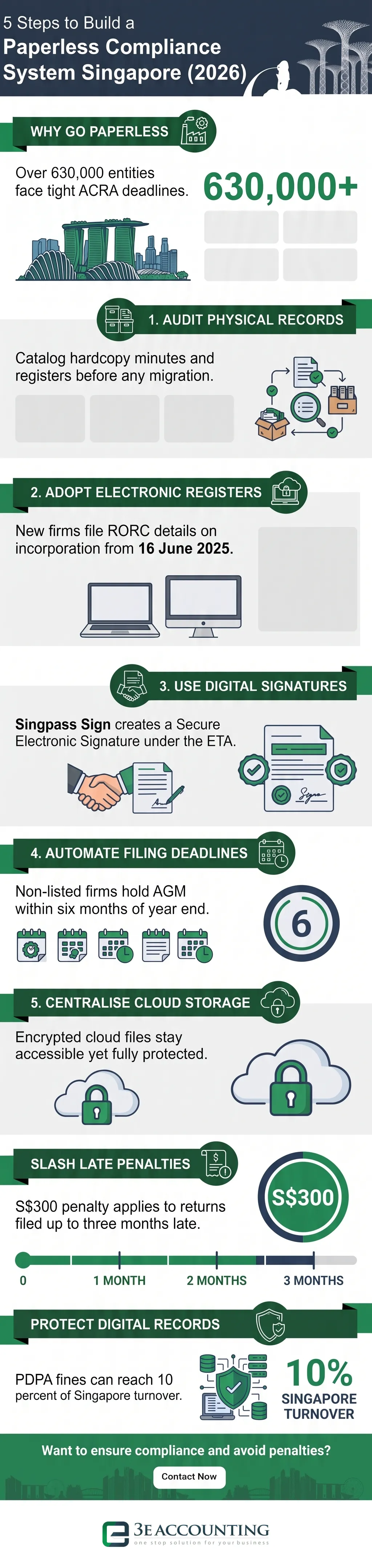
More than 630,000 business entities are registered with ACRA as of July 2026. Each one must maintain statutory registers, file Annual Returns and meet strict deadlines under the Companies Act 1967.
Paper-based records make timely updates difficult under the 14-day rule for statutory register changes. Non-listed companies must hold an annual general meeting within six months after their financial year end. These tight timelines raise the chance of S$300 late Annual Return penalties and higher enforcement costs. Many of these issues can be sidestepped by knowing the common compliance pitfalls new Singapore businesses face in 2026 and how to avoid them.
A paperless approach for Singapore companies combines electronic registers, digital signatures and cloud storage. It eliminates physical filing delays while meeting ACRA and IRAS obligations. Firms that act in 2026 gain efficiency and stronger data governance ahead of further digital mandates.
In this blog, we discuss five practical steps to build a paperless compliance system: auditing physical records, adopting electronic registers, using digital signatures, automating filing deadlines and centralising cloud storage.
How Do You Audit Physical Records?
Start by cataloguing every hardcopy minute, resolution and statutory register to establish a complete baseline before migration.
Companies must notify ACRA of register changes within 14 days. Begin by listing every hardcopy board minute, resolution and statutory register currently held. This inventory reveals gaps that paper systems hide. A complete baseline prevents incomplete digital migration and later ACRA queries. Once catalogued, records can be scanned and indexed for the next steps. We help clients complete this audit so the transition stays on schedule. To discuss your paperless migration, contact us for a consultation.
How Do You Adopt Electronic Registers?
ACRA accepts electronic formats for registers of members, directors and controllers, with automatic updates via Bizfile.
New companies must lodge Register of Registrable Controllers details on the day of incorporation from 16 June 2025. Migrate existing registers of members, directors and controllers into ACRA-accepted electronic formats. These registers are maintained electronically and remain convertible to a readable form for inspection. Lodgements and updates are then filed through Bizfile, ACRA's online portal. This step satisfies the private RORC and new central nominee registers. Digital registers cut transcription errors and support remote access. For businesses seeking quick company incorporation Singapore, paperless registers can be set up from day one.
How Do You Use Digital Signatures?
Singpass Sign produces a legally recognised Secure Electronic Signature under the Electronic Transactions Act for remote execution.
Sign with Singpass produces a Secure Electronic Signature recognised under the Electronic Transactions Act. Board resolutions, minutes and shareholder consents can now be executed remotely without wet-ink paper. The signature carries legal presumptions of authenticity and integrity. Directors and members sign from any location while the audit trail stays complete. This workflow removes courier delays and physical storage needs. It forms a core part of any digital corporate compliance Singapore setup.
How Do You Automate Filing Deadlines?
Compliance software tracks AGM dates, Annual Return filings and tax deadlines, sending alerts before penalties apply.
Non-listed companies face a S$300 penalty for late Annual Returns and must hold an AGM within 6 months of financial year end. Deploy compliance software to track AGM schedules, Annual Return filings and corporate tax dates. Automated alerts prevent missed deadlines and higher S$600 charges. The same system can incorporate GST InvoiceNow requirements for paperless tax invoices. Teams should also review gst e-invoicing requirements to align with the InvoiceNow mandate. Continuous monitoring keeps the company in good standing year-round. This automation is essential for a reliable paperless compliance system.
Singapore Compliance Deadlines and Penalties
| Requirement | Deadline | Penalty for Non-Compliance |
|---|---|---|
| Notify ACRA of register changes | Within 14 days of change | Compliance action by ACRA |
| Hold AGM (non-listed companies) | Within 6 months of FYE | S$300 late Annual Return penalty |
| File Annual Return (private companies) | Within 7 months of FYE | S$300 within 3 months late; S$600 beyond |
| Lodge RORC (new companies) | Day of incorporation (from 16 June 2025) | Compliance action by ACRA |
| Meet PDPA protection obligation | Ongoing | Up to 10% of Singapore turnover or S$1 million |
How Do You Centralise Cloud Storage?
Encrypted cloud repositories with role-based permissions replace physical cabinets and create an instant audit trail.
Encrypted cloud repositories with role-based permissions keep every scanned minute and register in one secure location. Access logs create an instant audit trail for ACRA or internal reviews. Physical cabinets become unnecessary once the migration is complete. Regular backups and encryption meet data-protection expectations. The result is a paperless archive directors can consult from anywhere. Proper controls turn digitisation into a governance strength.
How Do You Slash Late Penalties?
Paperless tracking sends reminders before deadlines, helping companies avoid S$300 to S$600 in late-filing penalties.
Late Annual Return filings attract a S$300 penalty if lodged within three months of the deadline. Paperless tracking software issues reminders well before the seven-month window closes. Companies avoid the higher S$600 charge and further enforcement action. Administrative time spent on paper files drops sharply. The same alerts cover AGM and tax dates. Digitisation therefore delivers both cost savings and continuous compliance.
How Do You Protect Digital Records?
Encryption, role-based permissions and audit logs satisfy PDPA protection obligations for digital registers.
The Personal Data Protection Commission may impose a financial penalty of up to 10 percent of annual Singapore turnover or S$1 million. Unencrypted files or weak controls during digitisation create the exposure the PDPA targets. Role-based permissions, encryption and audits close those gaps. Directors remain accountable for personal data held in registers. A secure cloud setup completes the paperless compliance system for Singapore companies.
Start Your Paperless Transition
Our corporate services team sets up electronic registers, digital workflows and automated tracking for Singapore companies.
Frequently Asked Questions
ACRA accepts electronic formats for the Register of Members, directors, secretaries and the private Register of Registrable Controllers provided they remain convertible to a readable form.
Yes. Signatures created with Singpass Sign qualify as Secure Electronic Signatures under the Electronic Transactions Act and carry legal presumptions of authenticity.
Private companies generally file the Annual Return within seven months after the financial year end.
Encryption, role-based access and audit logs help organisations satisfy the protection obligation and reduce the risk of a notifiable data breach.
Yes. A provider can audit existing records, establish electronic registers, implement signature workflows and install deadline-tracking tools so the company stays compliant.

Abigail Yu
Author
Abigail Yu oversees executive leadership at 3E Accounting Group, leading operations, IT solutions, public relations, and digital marketing to drive business success. She holds an honors degree in Communication and New Media from the National University of Singapore and is highly skilled in crisis management, financial communication, and corporate communications.