
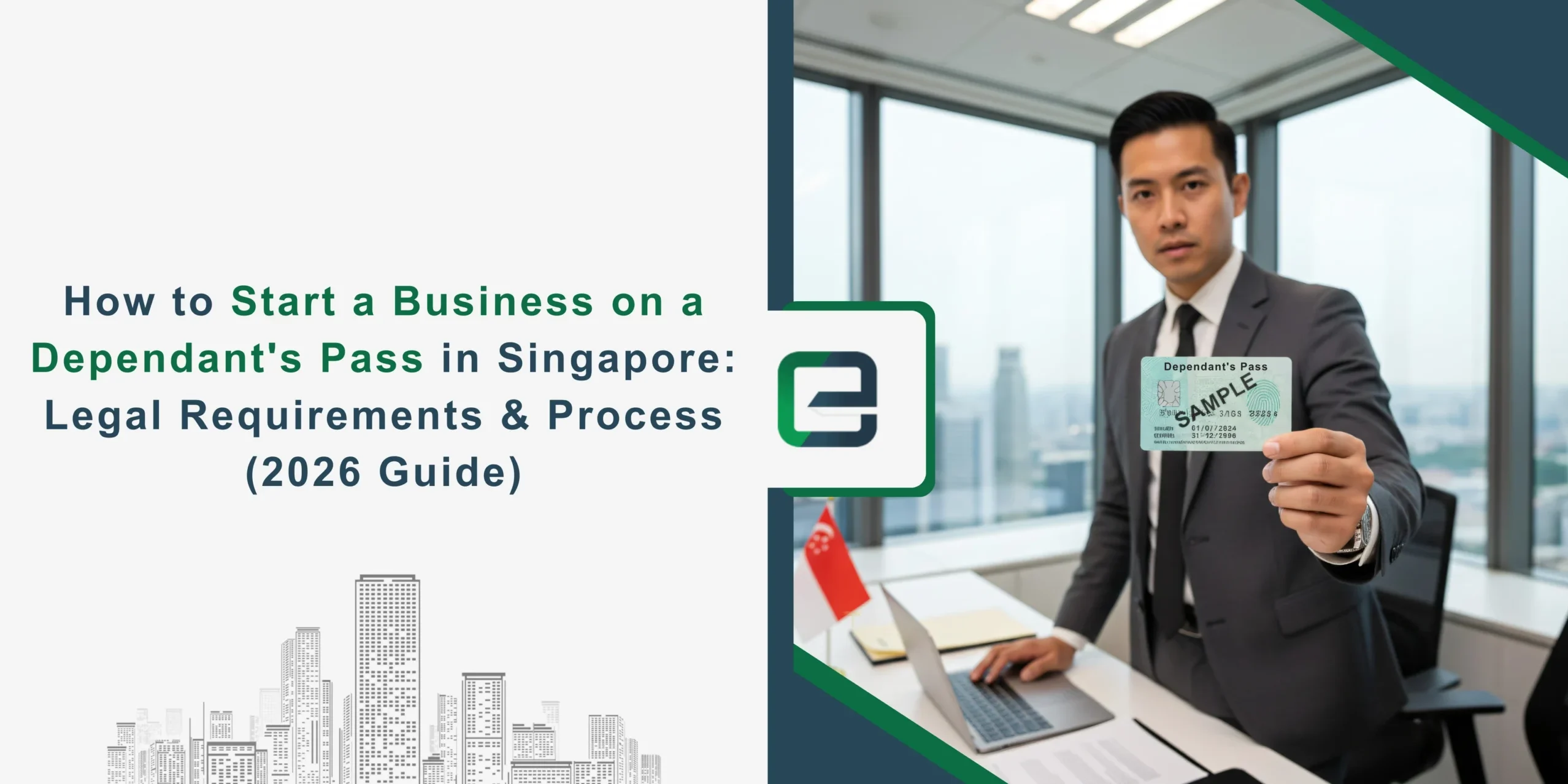
Can a Dependant Pass holder in Singapore truly build a business of their own? The answer is yes, but strictly within Singapore’s regulated immigration and corporate governance framework. According to Singapore’s Ministry of Manpower (MOM), Dependant’s Pass holders are not automatically entitled to work or operate a business. They must comply with specific work authorisation requirements, including obtaining a Letter of Consent (LOC) where applicable, or transitioning to a relevant work pass, depending on their business structure and level of involvement.
At the same time, all businesses in Singapore must be registered with the Accounting and Corporate Regulatory Authority (ACRA) under the Companies Act 1967. Every private limited company must appoint at least one locally resident director, maintain statutory registers, and comply with annual filing obligations.
This guide explains the legal requirements and procedural steps to help Dependant’s Pass holders structure and launch a business in Singapore with confidence in the regulatory framework.
What is a Dependant Pass in Singapore?
A Dependant’s Pass is a long-term, renewable visa issued by the Ministry of Manpower in Singapore. DP allows children and the legally married spouses of Employment Pass, S Pass, or EntrePass holders to reside in Singapore. The main pass holder must earn at least $ 6,000 per month to be eligible for a Dependant’s Pass.
A DP holder who wishes to start a business in Singapore must comply with company incorporation rules and secure proper work authorisation before engaging in any commercial activity. In practice, this means that while it is legally possible for a Dependant Pass holder to start a business in Singapore, it is not automatic and is subject to clear regulatory conditions.
Key Details About the Dependant Pass in Singapore You Should be Aware of:
Eligibility to Start Your Business
A Dependant Pass holder may incorporate a business in Singapore and act as a shareholder. However, to actively manage or operate the business, the individual must obtain appropriate work authorisation, typically through a Letter of Consent (LOC) or by converting to an Employment Pass, subject to prevailing MOM criteria.
Business Structures Available
DP holders most commonly establish a Private Limited Company, as it aligns with Singapore company incorporation requirements and facilitates future Employment Pass applications. Sole proprietorships and partnerships are legally permissible but may present practical challenges for work pass approval.
Work Authorisation Requirements
Starting a business in Singapore on a Dependant Pass requires prior approval from MOM. Without an approved LOC or valid Employment Pass, a DP holder cannot lawfully engage in business operations, even if listed as a company director or shareholder.
Company Incorporation Process
All businesses must be registered with the Accounting and Corporate Regulatory Authority (ACRA). Incorporation requires at least one locally resident director, a registered Singapore address, and compliance with statutory filing obligations.
Can a Dependant Pass Holder Start a Business in Singapore?
Individuals can start a business in Singapore on a Dependent Pass if they have a Letter of Consent (LOC) from the Ministry of Manpower to operate it. The DP holder must be an owner or a company director with a minimum 30% shareholding in an ACRA-registered business.
Key requirements for starting a business in Singapore on a Dependant Pass:
Letter of Consent (LOC) Requirement
A Letter of Consent is mandatory for a Dependant Pass holder to work in Singapore or operate their own business. The LOC functions as formal authorisation from MOM, allowing the DP holder to engage in day-to-day business activities.
Salary/Working Constraints
While a Dependant Pass holder with an approved LOC may operate the business, restrictions may apply to drawing a salary, particularly when serving as both a director and a shareholder. Compensation structures must align with current MOM policy frameworks.
Alternative Pathway
If the proposed business does not meet LOC eligibility requirements, the DP holder may need to apply for an EntrePass, a separate work visa designed for foreign entrepreneurs seeking to start and operate innovative businesses in Singapore.
What Business Structures are Available for Dependant Pass Holders?
Dependant Pass holders in Singapore can establish and operate a business, provided an LOC is obtained. Available business structures include private limited companies with ACRA, sole proprietorships, and LLPs. The table discusses the business structures which are available for Dependant Pass Holders:
| Requirement | Details | Deadline | Important Notes |
|---|---|---|---|
| Sole Proprietorship | Yes | Yes | Must register with ACRA; DP holder must obtain Letter of Consent (LOC) from MOM. Suitable for small, low-risk businesses but limited scalability. |
| Partnership | Yes | Yes | ACRA registration required; LOC mandatory for active involvement; shared liability. Suitable if partnering with a local or other foreign resident. |
| Private Limited Company (Pte Ltd) | Yes | Yes | Must appoint at least one local resident director; ACRA registration required; LOC needed if DP holder actively manages. Most preferred structure due to limited liability and scalability. |
| Shareholder Only (Passive Investor) | Yes | No (if not involved in operations) | May hold shares without LOC, but cannot work or manage the company without approval. Suitable for passive investment only. |
| EntrePass Business (Alternative Route) | Not under DP | Not applicable | Must apply for EntrePass under MOM if LOC eligibility is not met. Suitable for innovative or venture-backed startups. |
How to Start a Business in Singapore on a Dependant Pass?
Nine steps follow, in verified chronological order. Completing them out of sequence, particularly commencing business activity before both ACRA registration and LOC approval are secured, is a breach of Dependant’s Pass conditions. The consequences can include cancellation of the pass, penalties for the principal pass holder, and debarment from future pass applications. There are no shortcuts that do not carry this risk.
STEP 1: Assess Your Business Idea, Sector, and Legal Structure
Before any registration is submitted, determine whether your intended business activity is legally permissible for a foreign national operating under a Dependant’s Pass in Singapore. Certain sectors, including licensed financial services, legal practice, and specific healthcare subcategories, have regulatory requirements that operate independently of MOM’s LOC framework and must be addressed on their own terms.
STEP 2: Reserve Your Business Name on BizFile+ (ACRA)
All business name reservations and registrations in Singapore are handled through BizFile+, the digital platform operated by the Accounting and Corporate Regulatory Authority (ACRA) at bizfile.gov.sg. Begin by searching the portal to confirm your proposed name is available and does not closely resemble an existing registered entity.
- ACRA fee: S$15 for a business name application. The reservation, once approved, typically within one working day, is valid for 60 days, which may be extended for a further 60 days if required.
- A trademark search via the Intellectual Property Office of Singapore (IPOS) is strongly advisable at this stage. ACRA approval of a business name does not confer trademark protection, and registering a name that infringes on an existing mark creates legal exposure that only becomes apparent once the business is operational.
Important for foreigners: DP holders without a SingPass ID cannot transact directly on BizFile+. A registered filing agent, a law firm, an accounting firm, or a corporate secretarial firm must submit the application on their behalf. This is standard practice, and most corporate service providers, such as 3E Accounting in Singapore, include it in their standard incorporation packages.
STEP 3: Register Your Business with ACRA
With your business name reserved, proceed to register the entity on BizFile+. The official government fees, confirmed from ACRA’s published fee schedule, are as follows:
Sole Proprietorship or Partnership
- S$15 (name application) + S$100 (registration fee) = S$115 total ACRA government fee.
- Annual renewal is S$30.
Private Limited Company (Pte Ltd)
- S$15 (name application) + S$300 (incorporation fee) = S$315 total ACRA government fee.
- An annual filing fee of S$60 applies thereafter.
For a Pte Ltd, the incorporation also requires a company constitution (the Model Constitution provided by ACRA may be adopted) and consent forms from all directors and shareholders. If all parties authenticate digitally via SingPass, separate physical consent forms do not need to be submitted to ACRA.
Upon successful registration, which is typically processed within minutes for straightforward applications or 14 to 60 days if referral to another government agency is required, ACRA issues a Unique Entity Number (UEN). This is your business’s permanent identifier across all government interactions. Download and retain your official ACRA Business Profile immediately; it is a required document for the LOC application.
STEP 4: Submit the Mandatory Pre-Screening Form to MOM
Before a formal LOC application can be filed through the myMOM Portal, MOM requires every DP holder seeking to run a business to submit a pre-screening request using the official government form. This is not an optional preliminary step for certain business types, and it is the mandatory gateway for all DP holders, regardless of whether the intended structure is a sole proprietorship, partnership, or Pte Ltd.
The form requires your DP details and FIN number, your ACRA business registration information (including UEN), and a description of your intended business activity. MOM’s standard processing time for the pre-screening is approximately one week. You will receive the outcome by email.
If approved, MOM will notify you to proceed with the formal LOC application via the myMOM Portal. Retain the approval email; it is evidence of cleared pre-screening for your records.
If not approved, MOM will communicate its reasons. An appeal mechanism exists for rejected applications. Do not proceed with the myMOM Portal application until you have received written pre-screening approval.
STEP 5: Open a Dedicated Corporate Bank Account
While not a formal MOM condition precedent to the LOC application, opening a dedicated business bank account is a practical necessity that most founders address at this stage, before LOC approval is in hand, so that the business is operationally ready to launch the moment the LOC is granted.
Standard documentation requirements include the ACRA Business Profile, the Memorandum and Articles of Association (for Pte Ltd entities), identification documents for all directors and major shareholders, and a completed application form.
STEP 6 Apply for the Letter of Consent via the myMOM Portal
The formal LOC application is filed through MOM’s myMOM Portal. This is the current, correct channel. The LOC for DP business owners is no longer processed through the EP Online portal, the legacy channel, which is no longer applicable to this application type. The application must be submitted by the business entity or a MOM-authorised employment agency, it cannot be self-filed by the DP holder directly.
STEP 7: Await Written LOC Approval Before Beginning Any Operations
This condition requires no elaboration beyond its plain statement: no business activity of any kind may commence until written confirmation of LOC approval has been received from MOM. Operating before approval, regardless of how advanced the ACRA registration is or how imminent approval appears, is a direct and enforceable breach of the Dependant’s Pass conditions.
- MOM issues the LOC approval in writing. Upon receipt, verify every detail with care: the registered business name, the UEN, your FIN, and the validity period of the LOC.
- First-time LOC validity: Whichever is shorter, one year from the date of issue or the expiry date of the Dependant’s Pass.
- Subsequent renewal validity: Up to the expiry date of the Dependant’s Pass. No hard one-year cap applies to LOC renewals; this is a meaningful distinction from the first-time grant.
The LOC ceases to be valid the moment the underlying Dependant’s Pass is cancelled or expires, or when the business is no longer active. Both scenarios require prompt follow-up action as described in Step 9.
STEP 8: Register for Tax and Obtain All Required Operating Licenses
GST registration: Registration with the Inland Revenue Authority of Singapore (IRAS) for Goods and Services Tax (GST) is mandatory when annual taxable turnover exceeds S$1 million, assessed on either a retrospective 12-month or prospective 12-month basis. Voluntary registration is available below this threshold and is often advantageous when suppliers and clients are predominantly GST-registered. The current GST rate is 9%.
Operating licenses: Any sector-specific license required for your business activity must be obtained before operations begin. The GoBusiness portal is the official channel for identifying and applying for operating licenses across all regulated industries in Singapore, including food and beverage, healthcare, education, childcare, and financial services.
CPF employer registration: If you intend to hire employees, which will become a hard requirement at the first LOC renewal, register with the Central Provident Fund (CPF) Board as an employer and comply with all obligations under the Employment Act, including mandatory CPF contributions for Singapore Citizens and Permanent Residents.
Registered office address: ACRA requires every registered business to maintain a local registered office address in Singapore. Virtual office services are widely available, fully compliant, and the standard solution for early-stage businesses without a dedicated commercial space.
STEP 9: Maintain Ongoing Compliance and Renew the LOC Before It Lapses
LOC renewal is not automatic, and the application must be filed through the myMOM Portal before the current LOC expires and, critically, when the Dependant’s Pass still has at least three months of validity remaining. An LOC renewal application submitted when fewer than three months remain on the DP will be rejected on that basis alone.
The renewal’s defining requirement: At the time of renewal, MOM requires documented evidence that the business has hired at least one Singapore Citizen or Permanent Resident who:
- earns at minimum the prevailing Local Qualifying Salary (LQS)
- has been receiving CPF contributions for at least three consecutive months immediately preceding the date the renewal application is submitted.
Both conditions must be satisfied simultaneously; partial compliance does not meet the standard.
LOC validity post-renewal: Each renewed LOC is valid up to the expiry date of the Dependant’s Pass. Renewing the DP in a timely manner is therefore a direct operational prerequisite: a lapsed DP voids the LOC simultaneously, regardless of where the LOC renewal cycle stands.
When the business closes: If the business becomes inactive or is wound down, the LOC must be cancelled via the myMOM Portal. This should be done before the business ceases operations. Operating under a cancelled or lapsed LOC, even inadvertently through delayed cancellation, constitutes a compliance breach.
Material changes: Any material change to the business, a restructuring that reduces a Pte Ltd director’s shareholding below 30%, a change in the registered nature of business activity, or a change to the principal pass holder’s pass status must be reported to MOM. Unreported material changes are a breach of LOC conditions.
Best Business Ideas for Dependant Pass Holders in Singapore
The best business ideas for dependent pass holders in Singapore focus on low-overhead, digital or home-based ventures such as e-commerce. Since May 2021, dependent holders must secure a proper work pass or an EntrePass to start a business in Singapore
| Business Idea | Suitable Structure | Why It Works for DP Holders | Licensing Required? | Scalability Potential |
|---|---|---|---|---|
| E-commerce Store (Shopee, Lazada, Shopify) | Sole Proprietorship / Pte Ltd | Low overhead, home-based, flexible operations | No sector license (unless regulated goods) | High – regional expansion possible |
| Digital Marketing Agency | Pte Ltd | Service-based, low capital requirement, remote-friendly | No | High – client-based scaling |
| Freelance Consulting (Finance, HR, Marketing) | Sole Proprietorship / Pte Ltd | Skill-driven, minimal setup cost | No (unless regulated advisory sector) | Moderate to High |
| Home-Based Baking / Food Business | Sole Proprietorship | Popular demand, low initial investment | Yes – SFA food license | Moderate |
| Tuition or Enrichment Services | Sole Proprietorship / Pte Ltd | Strong education demand in Singapore | Yes – MOE/SSG approval depending on scale | Moderate |
| Content Creation / Influencer Brand | Sole Proprietorship | Personal brand model, digital-first | No | High – sponsorships & ads |
| IT Services / Software Development | Pte Ltd | High-margin, scalable, strong market demand | No (unless fintech is regulated) | Very High |
| Import & Export Trading | Pte Ltd | Singapore is a trade hub | Yes – Customs registration | High |
| Corporate Services / Virtual Assistant Firm | Pte Ltd | Supports SME ecosystem | No (unless regulated services) | High |
Conclusion
In Singapore, the opportunity for a Dependant Pass holder to start a business is real, but it is structured, conditional, and firmly regulated. The pathway runs through proper ACRA incorporation, mandatory pre-screening, and formal approval from the Ministry of Manpower before any commercial activity begins. For founders navigating this framework, precision matters.
This is where 3E Accounting can provide strategic support, from company incorporation and nominee director arrangements to LOC coordination, tax registration, and ongoing compliance management. With regulatory familiarity and procedural discipline, the firm helps Dependant Pass holders establish a compliant, scalable presence in Singapore’s business landscape without missteps that could jeopardise their pass status or long-term plans.
Looking to Set Up a Company in Singapore as a Dependant’s Pass Holder?
Build your Singapore business on a Dependant’s Pass, compliant from day one with 3E Accounting.
Frequently Asked Questions
Yes, Dependant’s Pass (DP) holders can operate a business in Singapore, but they must first obtain a Letter of Consent (LOC) from the Ministry of Manpower. Eligible individuals must be owners of an ACRA-registered business, such as a sole proprietor, a partner, or a company director with at least a 30% shareholding. The business must also hire at least one Singaporean or permanent resident earning the prevailing local qualifying salary.
Yes, a Dependant Pass (DP) holder can open a personal bank account in Singapore. Major local banks (DBS/POSB, UOB, OCBC) generally allow this with valid documentation, such as a passport, the DP card, and proof of address. Online applications via SingPass are often possible, though in-person visits to a branch might be required.
Dependent visa restrictions vary significantly by country but generally include limitations on working, studying, and accessing public funds. Common constraints include ineligibility for public benefits, age limits for children (often under 18 or 21), and the requirement for dependents to leave if the primary visa holder’s status changes.
Yes, you can start a business in Singapore as a foreigner, as the country is highly business-friendly and allows 100% foreign ownership. Non-residents must appoint a local resident director and a company secretary, and maintain a registered physical address in Singapore. Registration must be done via a professional firm through ACRA.

Abigail Yu
Author
Abigail Yu oversees executive leadership at 3E Accounting Group, leading operations, IT solutions, public relations, and digital marketing to drive business success. She holds an honors degree in Communication and New Media from the National University of Singapore and is highly skilled in crisis management, financial communication, and corporate communications.