

What happens to your statutory registers, Bizfile access and filing calendar when your company secretary stops responding? That concern can make directors hesitate when it is time for a company secretary change in Singapore.
In this guide, we discuss the ACRA lodgment rules that govern a secretary change, a priority-first handover checklist, how to keep Bizfile and Corppass access under company control, and the 2026 compliance deadlines that continue regardless of who holds the role.
What Are the ACRA Rules for Changing a Company Secretary in Singapore?
A Singapore company may change its secretary at any time under its constitution, but ACRA must be notified through Bizfile within 14 days of the change.
The Accounting and Corporate Regulatory Authority (ACRA) treats the company secretary as an officer of the company. Both the new appointment and the outgoing cessation must be lodged through Bizfile within 14 days of the change.
Before lodging, the effective appointment and cessation dates must be settled. So must the corporate authority for the change and any endorsements the constitution requires. Filing a notification with uncertain dates creates its own exposure, because the public record drives every later filing and search.
Every company must have a company secretary, and the position cannot remain vacant for more than six months. That six-month figure is a legal ceiling, not a recommended handover timetable. A transition planned against the statutory maximum is a transition planned badly.
The replacement must be a natural person who is ordinarily resident in Singapore. The same person cannot act as both sole director and company secretary. These are the general local-company rules; specialist qualifications and listed-company requirements fall outside this article.
New boards often appoint the provider who handled their Singapore incorporation services, then outgrow that arrangement as filings grow more complex. Nothing prevents a switch, provided the lodgment and handover are handled cleanly.
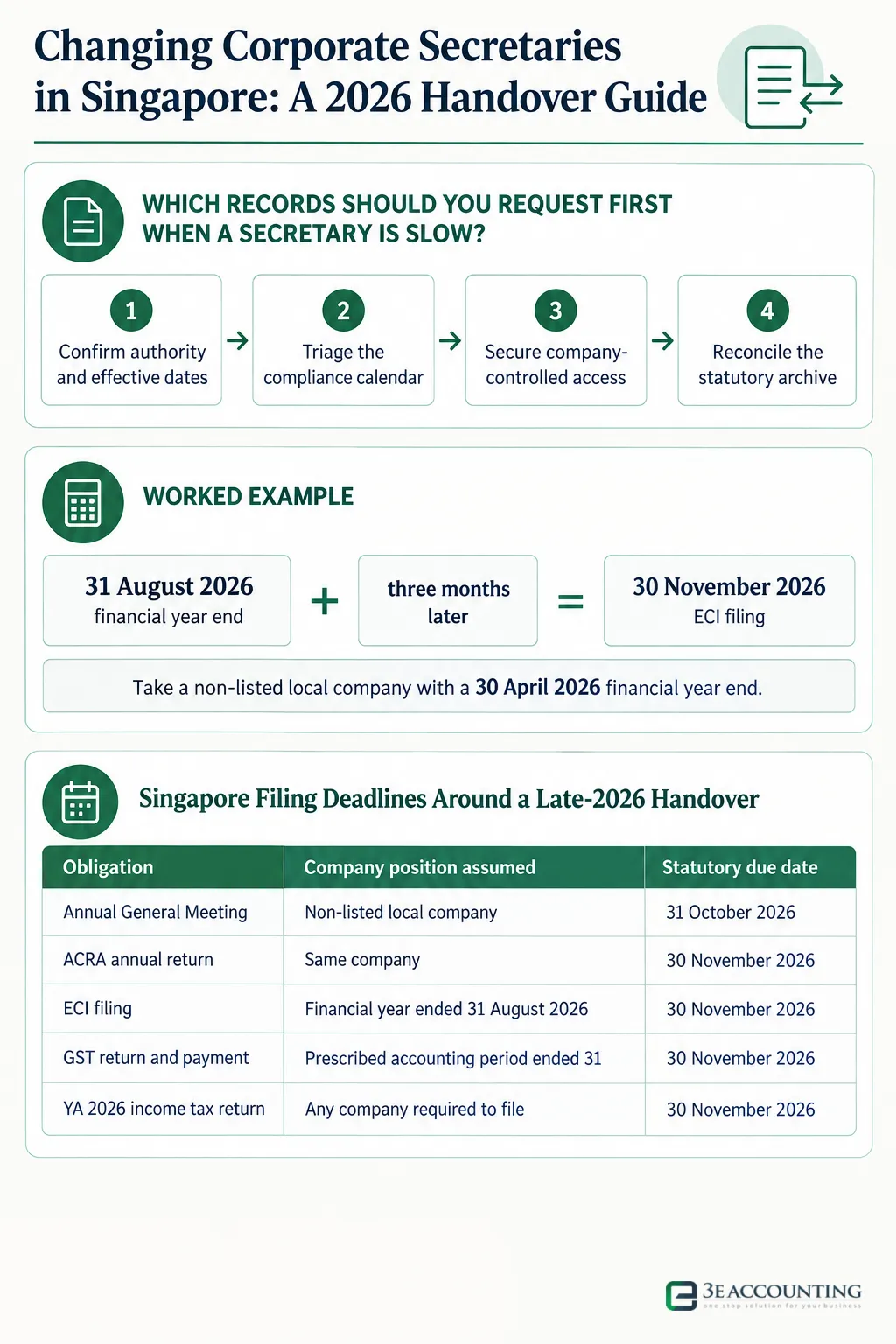
Which Records Should You Request First When a Secretary Is Slow?
Deadline-critical documents and company-controlled access come before the full historical archive.
When an outgoing provider responds slowly, the instinct is to wait for a complete file before acting. In our corporate secretarial work, that wait is usually the costliest error. We recommend a control-first sequence; it is a practical working order, not a statutory rule, and each company varies it.
1. Confirm authority and effective dates
Establish the board's authority for the change under the constitution, the agreed cessation date, and the incoming secretary's written consent and eligibility. Disputed dates and unclear authority stall handovers longer than any missing document.
2. Triage the compliance calendar
Pull a fresh business profile from ACRA, review current officers and filing history, and list every outstanding notice. Build a deadline schedule covering the annual return, Annual General Meeting (AGM), accounts, Estimated Chargeable Income (ECI), corporate income tax and GST where applicable.
3. Secure company-controlled access
Confirm that a company-controlled Corppass administrator can assign and remove users. Ask the outgoing provider for its engagement terms, termination correspondence, and a written schedule of filings completed, pending or awaiting director approval.
4. Reconcile the statutory archive
A staged transfer is acceptable; a vague assurance that everything has been sent is not. Request deadline-critical documents immediately, and hold the outgoing provider to a written missing-document list for the remainder.
ACRA Rules for Changing a Company Secretary
| Requirement | What ACRA expects | Timing or limit |
|---|---|---|
| Lodging the change | Appointment or cessation notified through Bizfile | Within 14 days of the change |
| Vacancy of the office | Company secretary position must not stay empty | No more than 6 months |
| Residency | Natural person who is ordinarily resident in Singapore | Continuous requirement |
| Sole-director companies | One person cannot be both sole director and secretary | Continuous restriction |
What Belongs in a Singapore Company Secretary Handover Checklist?
Constitutional records first, then registers, share documents, meeting records, filings and regulator correspondence.
The checklist below is a suggested framework, not a statutory form. We tailor it to each company's circumstances, and the final list should be confirmed against the company's own records and current legal requirements before it is relied on.
1. Constitutional and incorporation records
The constitution, certificate of incorporation and early notices anchor every later check. Without them, later resolutions cannot be tested against the company's own rules.
2. Registers and officer records
Request the register of members and share ledger, officer appointment and cessation documents, and the registers of registrable controllers (RORC), nominee directors and nominee shareholders. These are separate registers with their own notice duties, and exemptions apply; confirm which obligations bind the company. Controller and nominee records also intersect with wider know-your-customer duties, which our article on KYC regulations for Singapore companies sets out.
3. Share documents
Applications, allotment and transfer documents, stamp-duty evidence, share certificates and counterfoil or cancellation records. An ACRA extract alone does not prove that the underlying approvals and transaction documents exist.
4. Meetings and resolutions
Signed board and member resolutions, AGM minutes, and any exemption or dispensation records. Unsigned resolutions are among the most common gaps we find when reconciling a takeover file.
5. Filings, statements and correspondence
Filed returns, financial statements and XBRL files, plus all ACRA and Inland Revenue Authority of Singapore (IRAS) notices, assessments, acknowledgements and unresolved letters.
How Do You Transfer Bizfile Access Without Sharing Passwords?
Portal access is assigned, never shared: a change of secretary does not by itself change Corppass roles, tax-agent authorisations or bank mandates.
Under Corppass, access to government digital services is assigned and managed by the entity's Corppass administrator or sub-administrator, and each user verifies identity with Singpass credentials. The incoming provider should therefore receive its own properly authorised access through the company's structure. Our standing security recommendation is never to share Singpass credentials, passwords or one-time passwords (OTPs) with any provider.
A change of company secretary changes nothing else by itself. Corppass roles, IRAS tax-agent authorisation and bank mandates each run on their own processes. Treat them as a separate-access checklist, and follow the bank's and the agent's own authorisation procedures.
Access Points to Review After a Secretary Change
| Access point | Who controls it | What to do |
|---|---|---|
| Government e-services and Bizfile | Corppass administrator or sub-administrator | Assign the incoming provider's own access; remove outgoing users |
| myTax Portal | The company and its authorised tax agent | Confirm the agent's scope; authorise separately if needed |
| Banking mandates | The bank's own verification procedures | Update signatories under the bank's mandate process |
| Statutory registers | The company itself | Keep originals with the company; log any custody transfers |
Which 2026 Filing Deadlines Continue Through a Secretary Change?
All of them: a secretary change suspends no obligation, and the late-2026 window is unusually crowded.
Take a non-listed local company with a 30 April 2026 financial year end. ACRA's general position is that an AGM must be held within six months of year end, where one is required, and the annual return filed within seven months. That points to 31 October 2026 for the AGM and 30 November 2026 for the annual return. This assumes no AGM exemption or dispensation applies and there is no overseas branch-register obligation.
A company with a 31 August 2026 financial year end generally owes an ECI filing three months later, by 30 November 2026. IRAS relaxes this only where its waiver conditions are met, namely annual revenue of $5 million or below and nil ECI. Eligibility must be checked for the particular company, not assumed.
A GST-registered company whose prescribed accounting period ended 31 October 2026 must file its GST return and pay by 30 November 2026. The exact due date should be confirmed in myTax Portal. If your company has recently completed GST registration, the filing cycle applies from your first prescribed period.
IRAS requires all companies to file the Year of Assessment (YA) 2026 Corporate Income Tax Return by 30 November 2026 unless a waiver has been granted. This includes companies that made a loss or traded little; dormancy is not an automatic exemption. Late or non-filing can attract penalties of up to $5,000.
Dormancy deserves a separate warning. ACRA expects live companies to file annual returns even when inactive, and IRAS applies its own dormancy test before relaxing tax filings. Neither regulator's relief follows from a label, and each company's status must be checked on its own facts.
Who Owns a Filing That Falls Due Mid-Handover?
One named filer per obligation; shared or assumed responsibility is where filings get lost.
In transitions we manage, each obligation is assigned in a written transition schedule. A workable template carries these columns: entity, obligation, reporting period, official due date, preparer, reviewer, director approval date, authorised filer, submission status and receipt location. We present this as a generic template, not a statutory or industry-mandated form.
The company and its responsible officers keep their statutory obligations despite any outsourcing. Directors remain answerable for timely and accurate filings, even where an agent acts. The outgoing provider should handle a mid-handover filing only if its continuing engagement, access and written acceptance are confirmed. Otherwise the incoming team, or a separately appointed tax agent, takes ownership.
Appointing a new company secretary does not automatically appoint a tax agent; authorisation with IRAS is a separate step. An overdue annual return, GST return, ECI filing or income tax return does not heal because a new secretary signed on. Appointment and remediation usually run in parallel. We do not promise that this avoids penalties; it prevents the position from quietly worsening.
Where an outgoing provider stalls, an escalation framework might run from a written request to a diary follow-up, then escalation to the directors, and finally a formal demand for release of records. That sequence is an example; the binding version is the engagement's own terms.
Singapore Filing Deadlines Around a Late-2026 Handover
| Obligation | Company position assumed | Statutory due date | Basis |
|---|---|---|---|
| Annual General Meeting | Non-listed local company, financial year ended 30 April 2026 | 31 October 2026 | Six months after year end, where an AGM is required |
| ACRA annual return | Same company | 30 November 2026 | Seven months after year end for non-listed companies |
| ECI filing | Financial year ended 31 August 2026 | 30 November 2026 | Three months after year end, subject to the ECI waiver |
| GST return and payment | Prescribed accounting period ended 31 October 2026 | 30 November 2026 | One month after period end; confirm in myTax Portal |
| YA 2026 income tax return | Any company required to file | 30 November 2026 | Unless a filing waiver has been granted |
Should the Appointment Be Lodged Before or After Records Verification?
Lodge once a short control threshold is met; the historical archive can be reconciled afterwards.
The threshold we work to is deliberately short. Confirm corporate authority, the appointment and cessation dates, the incoming secretary's eligibility and consent, company-controlled access, and the immediate deadline list. Meeting that threshold is enough to notify ACRA through Bizfile. Waiting for a perfect archive only widens the ownership vacuum around the next deadline.
This is general operational guidance from our practice, not a rule set by any regulator. Where authority, ownership, resignation terms or records are disputed, take legal advice before lodging.
Conclusion
Changing a company secretary in Singapore is a controlled, deadline-first exercise. Establish authority and dates, lodge the change with ACRA through Bizfile within 14 days, and secure company-controlled Corppass access. Never let the six-month vacancy ceiling become the plan.
The registers, resolutions, share documents and regulator correspondence can then be reconciled against a written missing-document list, while every obligation keeps a named filer. The annual return, ECI, GST and YA 2026 income tax return deadlines all continue untouched by the switch.
Our corporate secretarial team at 3E Accounting Singapore, an ACRA-registered corporate services provider, handles appointments, cessations, Bizfile lodgments and full handover checklists for Singapore companies. Speak with us before the next filing lands.
Plan Your Company Secretary Handover
Our Singapore corporate secretarial team manages the lodgment, records checklist and filing calendar so nothing slips during the transition.
Frequently Asked Questions
Within 14 days of the change, through Bizfile. Effective dates, corporate authority and any required endorsements should be settled before lodging.
Not beyond six months. That is a statutory ceiling, not a handover timetable; a disciplined transition works to weeks, not months.
No. Annual-return, GST, ECI and income-tax obligations continue independently of the appointment. Appointment and remediation usually run in parallel, and penalties are not guaranteed to be avoided.
No. Access is assigned by the company's Corppass administrator, and users authenticate with their own Singpass. Credentials, passwords and one-time passwords should never be shared.
Generally, yes. ACRA expects live companies to file annual returns even when inactive, and IRAS applies a separate dormancy test for tax filings. Check each company's status and any waiver.

Abigail Yu
Director
Abigail Yu oversees executive leadership at 3E Accounting Group, leading operations, IT solutions, public relations, and digital marketing to drive business success. She holds an honors degree in Communication and New Media from the National University of Singapore and is highly skilled in crisis management, financial communication, and corporate communications.