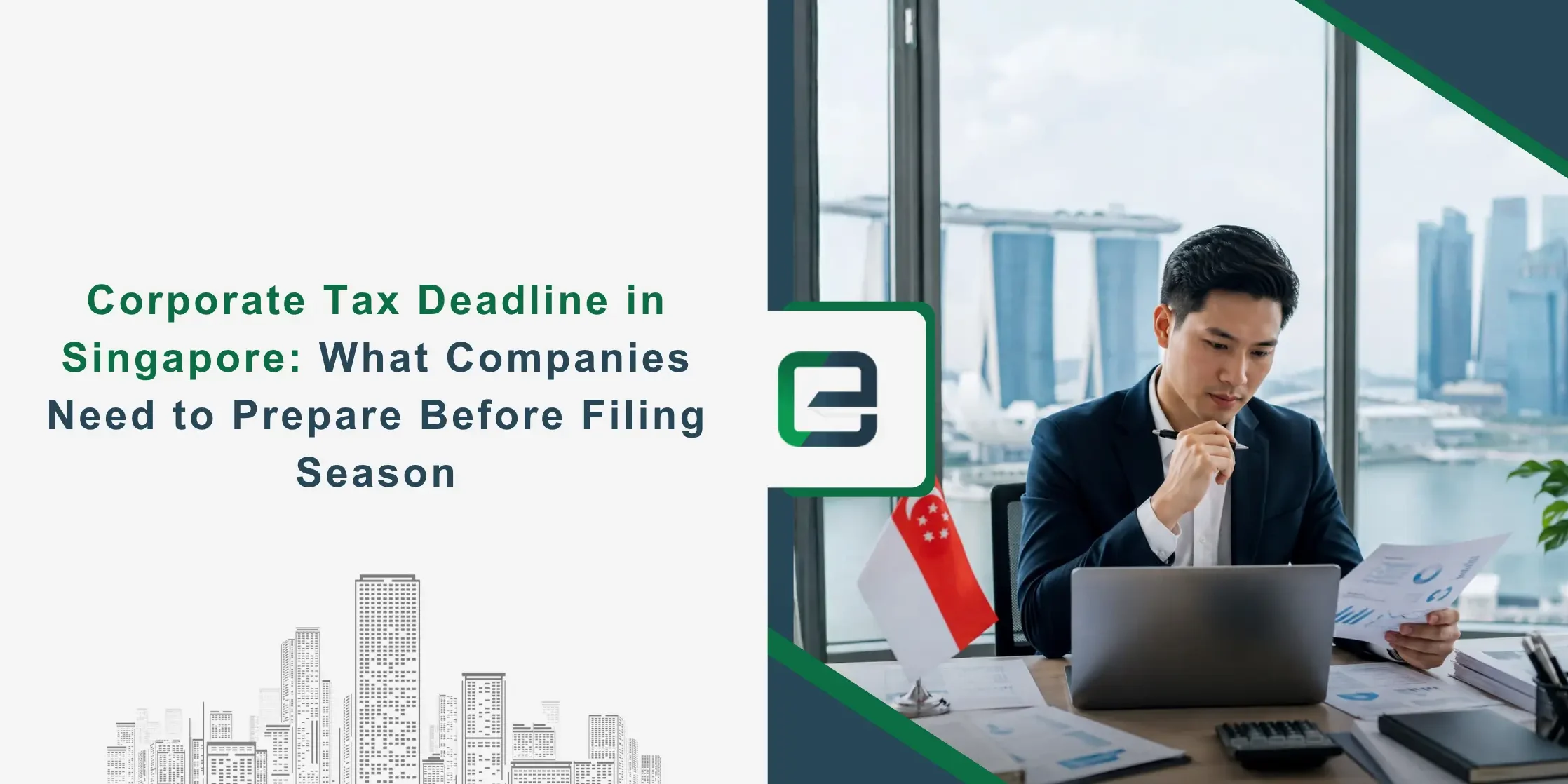
Corporate tax filing is a mandatory annual compliance requirement for all companies in Singapore under the Inland Revenue Authority of Singapore (IRAS). For the Year of Assessment (YA) 2026, all companies must file their Corporate Income Tax Return by 30 November 2026, including companies with no income or business activity. If your company is inactive, reviewing the singapore holding companies dormancy filing rules 2026 will help you confirm exactly what still needs to be submitted.
Singapore’s corporate tax system is highly competitive, offering a 17% tax rate along with incentives and relief schemes for eligible businesses. As filing season approaches, companies should review financial records, note key deadlines, and evaluate tax incentives to ensure timely and accurate compliance.
This guide covers everything businesses need to know before the YA 2026 filing season, including corporate tax deadlines, filing requirements, required documents, available tax reliefs, and the penalties for late or incorrect submissions.
What is Corporate Income tax in singapore?
Corporate Income Tax (CIT) is a tax imposed on the taxable profits of companies operating in Singapore. It applies to both Singapore-incorporated companies and foreign companies in Singapore.
Some of the key features of Singapore’s corporate tax framework include:
- 17% flat corporate tax rate for resident and non-resident companies
- Start-Up Tax Exemption (SUTE) scheme, offering eligible startups tax exemptions of up to S$125,000 over their first three Years of Assessment
- Partial Tax Exemption (PTE) scheme for qualifying companies beyond the startup period
- One-tier corporate tax system, where dividends paid to shareholders are generally tax-exempt
- 50% Corporate Income Tax Rebate for YA 2026, capped at S$40,000 per company
To help businesses manage rising operating costs, the Government has enhanced the YA 2026 Corporate Income Tax Rebate from 40% to 50% of the corporate tax payable, subject to a maximum rebate of S$40,000 per company. The rebate will be automatically applied by IRAS based on the company’s tax filings, reducing the overall tax burden for eligible businesses.
Corporate Tax Deadlines in Singapore (ECI, Form C & Form C-S)
Companies in Singapore are generally required to complete two corporate tax filings each year: the Estimated Chargeable Income (ECI) filing and the annual Corporate Income Tax Return. For a broader view, see the 7 compliance deadlines Singapore startups must track in 2026 to stay ahead of all upcoming obligations.
1. Estimated Chargeable Income (ECI)
Estimated Chargeable Income (ECI) is an estimate of a company’s taxable profits for a Year of Assessment (YA) after deducting tax-allowable expenses. Unless exempted, companies must file their ECI with IRAS within three months from the end of their financial year.
Upcoming Deadlines:
Financial Year End: 31 March 2026
ECI Due Date: 30 June 2026
Companies with annual revenue of S$5 million or less and nil ECI for the YA may qualify for an exemption from ECI filing. For eligible businesses, filing ECI early may also provide access to instalment payment arrangements for corporate tax liabilities.
2. Corporate Income Tax Return
All companies in Singapore, including dormant and loss-making companies, are required to file an annual Corporate Income Tax Return with IRAS.
The type of tax return a company must file depends on its annual revenue and eligibility criteria:
| Tax Form | Eligibility | Deadline |
|---|---|---|
| Form C-S (Lite) | Companies with annual revenue of S$200,000 or less and straightforward tax affairs | 30 November 2026 |
| Form C-S | Companies with annual revenue of S$5 million or less that meet IRAS qualifying conditions | 30 November 2026 |
| Form C | Companies with annual revenue exceeding S$5 million or those that do not qualify for Form C-S filing | 30 November 2026 |
The Corporate Income Tax filing window for Year of Assessment 2026 opens on 1 May 2026 and closes on 30 November 2026, giving companies a clear compliance period within which all Form C-S (Lite), Form C-S, and Form C submissions must be completed via the IRAS myTax Portal.
Who Needs to File Corporate Tax in Singapore?
Most companies registered or operating in Singapore must file corporate tax returns, regardless of whether they made a profit, incurred losses, or were dormant during the financial year.
IRAS receives over 300,000 Corporate Income Tax Returns annually, with a record 90.4% on-time filing rate achieved in YA 2024. This indicates the importance of timely tax compliance for businesses across Singapore.
The following entities are generally required to file corporate tax returns:
- Singapore-incorporated companies
- Foreign companies and branches operating in Singapore
- Companies with a permanent establishment in Singapore
- Dormant companies, even if they had no business activity or income during the year
Documents Required for Corporate Tax Filing
Preparing the right documents before filing helps ensure accurate reporting and reduces the risk of queries, errors, or delays during filing.
The documents required may vary depending on whether the company is filing Form C-S (Lite), Form C-S, or Form C, but most businesses should prepare the following:
- Financial statements (Profit & Loss Statement and Balance Sheet)
- Tax computation showing how accounting profit is adjusted to taxable income
- Supporting schedules and working papers
- Revenue and sales records
- Details of tax deductions, allowances, and reliefs claimed
- Documents supporting tax incentive or rebate claims
- Previous tax assessments and IRAS notices, where applicable
Companies filing Form C are generally required to submit their financial statements, tax computation, and supporting documents to IRAS. Companies filing Form C-S or Form C-S (Lite) are not required to submit these documents upfront but must prepare and retain them in case IRAS requests supporting records during a review.
How to file your Corporate Income Tax Return in Singapore?
Filing Corporate Income Tax in Singapore involves a series of steps, from estimating taxable income to submitting the final tax return with IRAS.
Step 1: Submit Your Estimated Chargeable Income (ECI)
Unless exempted by IRAS, companies must submit their ECI within 3 months of the end of their financial year.
Step 2: Finalise Your Financial Information
Check your financial statements, taxable income calculations, and supporting records to make sure everything you report is complete and accurate.
Step 3: Choose the Right Filing Form
Based on your company’s revenue and eligibility, you will need to file either Form C-S (Lite), Form C-S, or Form C. The correct forms ensures smoother and faster IRAS processing.
Step 4: File Using the IRAS myTax Portal
Submit your tax return online through the IRAS myTax Portal with CorpPass by 30 November of the assessment year.
Step 5: Receive Your Tax Assessment
Once your return is processed, IRAS will issue a Notice of Assessment (NOA) to confirm how much tax your company needs to pay, if any.
What Are the Penalties for Late or Incorrect Corporate Tax Filing in Singapore?
Failing to file or pay Corporate Income Tax on time can result in penalties, enforcement actions, and additional compliance scrutiny from IRAS.
Late or Non-Filing of Tax Returns
Companies that fail to submit their Corporate Income Tax Return on time may face:
- An Estimated Notice of Assessment (NOA) based on available information
- Financial penalties of up to S$5,000 per offence
- Court summons or legal action for continued non-compliance
Late Payment of Corporate Tax
Corporate tax is generally payable within one month from the date of the Notice of Assessment (NOA). Companies that miss the payment deadline may face:
- A 5% late payment penalty on the unpaid tax
- Additional penalties of 1% per month, capped at 12% of the outstanding amount
- Recovery actions by IRAS to collect unpaid taxes
Incorrect Tax Returns
Submitting incorrect corporate tax information during the YA 2026 filing window (1 May 2026 to 30 November 2026) can also result in penalties and audits. Common compliance issues include:
- Under-reporting income
- Claiming incorrect deductions or reliefs
- Providing incomplete or inaccurate information
Maintaining accurate records and reviewing filings before submission can help businesses avoid unnecessary penalties and remain compliant with IRAS requirements.
How to View Your Singapore Corporate Income Tax Filing Status?
After submission, Companies can monitor the status of their Corporate Income Tax filings through the IRAS myTax Portal using CorpPass. This service allows companies to review:
- Corporate Income Tax return submission status
- Tax assessment status
- Supporting document submissions
- Outstanding tax-related actions or requests
Businesses and authorised tax agents can also use the “Chat with IRAS” service to check Corporate Income Tax filing, assessment, payment, and GIRO statuses using the company’s Unique Entity Number (UEN).
Checking your status periodically helps ensure submissions have been processed successfully and any outstanding tax obligations are addressed in a timely manner.
Conclusion
Early preparation for corporate tax filing helps businesses avoid last-minute issues, reduce compliance risks, and meet IRAS requirements for Year of Assessment (YA) 2026. With key timelines such as the ECI deadline (within 3 months of financial year-end in 2026) and the Corporate Income Tax Return filing deadline on 30 November 2026, staying ahead of schedule is essential for smooth compliance.
Understanding these deadlines, maintaining accurate financial records throughout FY 2025–2026, and submitting the correct forms between 1 May 2026 and 30 November 2026 ensures a more efficient and stress-free YA 2026 filing process.
For both new and extinct businesses, 3E Accounting Singapore offers comprehensive support, from ECI submissions and tax computations to Corporate Income Tax Return filing and compliance advisory. Our team helps businesses stay compliant and minimise administrative burden.
Get Expert Help With Corporate Tax Filing in Singapore
Stay compliant with IRAS deadlines. 3E Accounting helps you manage end-to-end corporate tax filing in Singapore with ease.
Frequently Asked Questions
For YA 2026, companies must file their Estimated Chargeable Income (ECI) within 3 months after their financial year-end, and submit the Corporate Income Tax Return by 30 November 2026.
Singapore applies a flat 17% corporate tax rate on chargeable income. However, the effective tax payable is often reduced through exemptions, rebates, and incentive schemes.
Yes. Dormant companies are generally required to meet their corporate tax filing obligations, even if they did not generate income or carry out business activities during the financial year.
If a company fails to file its Corporate Income Tax Return on time, IRAS may issue an Estimated Notice of Assessment (NOA) based on available information. The company may also face penalties of up to S$5,000 per offence, along with enforcement actions such as court summons for continued non-compliance.
Companies can check their filing status through the IRAS myTax Portal using CorpPass. The portal allows businesses to view filing submissions, tax assessments, the status of supporting documents, and outstanding tax matters.
Yes. Companies may appoint a tax agent to prepare and submit tax filings. However, company directors remain responsible for ensuring all information submitted to IRAS is accurate and filed on time.

Abigail Yu
Author
Abigail Yu oversees executive leadership at 3E Accounting Group, leading operations, IT solutions, public relations, and digital marketing to drive business success. She holds an honors degree in Communication and New Media from the National University of Singapore and is highly skilled in crisis management, financial communication, and corporate communications.